
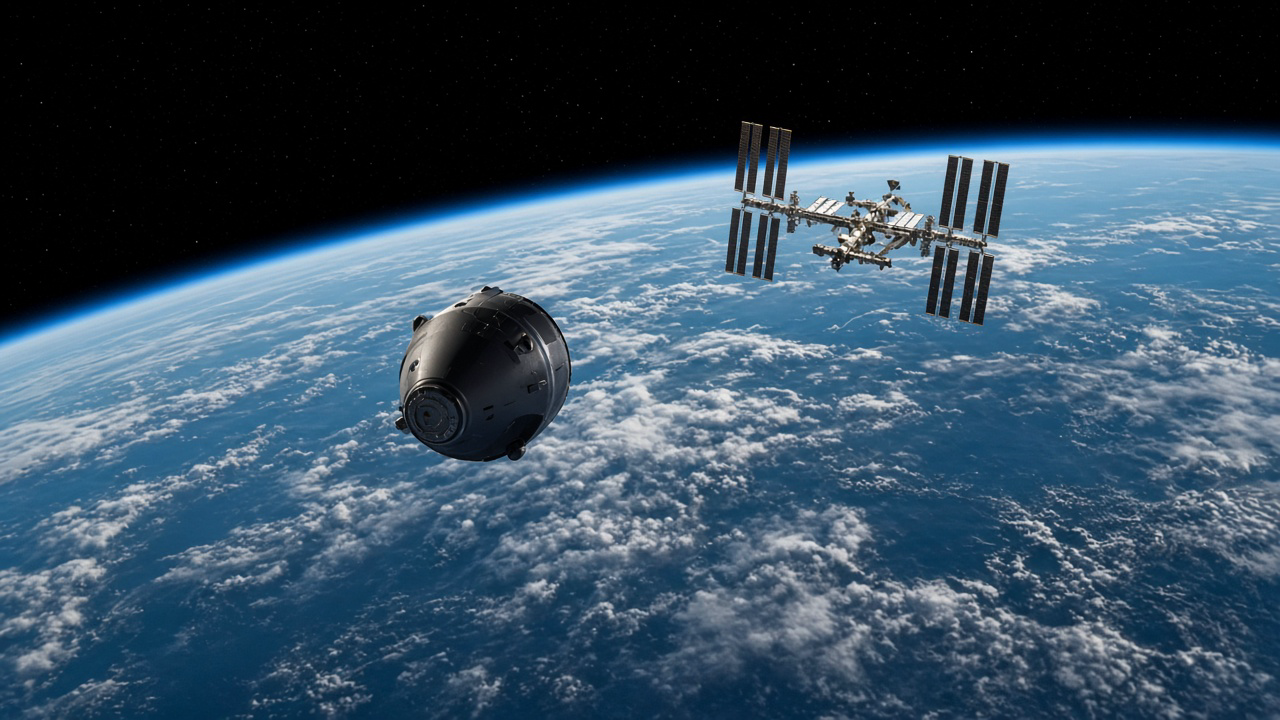
Liftoff happened. At 11:10 a.m. EDT on Thursday, Oct. 1, a SpaceX Falcon 9 rose from Space Launch Complex 40 at Cape Canaveral and put NASA’s SpaceX Crew-13 into orbit aboard Crew Dragon Grace. At 7:05 p.m. EDT the same day, Grace docked to Harmony’s forward port after 7 hours and 55 minutes on orbit — the fastest launch-to-docking of a U.S. spacecraft in Station history. Hatches opened at 9:19 p.m. EDT, and Canada’s Joshua Kutryk plus crewmates Jessica Watkins, Luke Delaney, and Sergey Teteryatnikov joined Expedition 75 for a roughly six-month stay.
Weather had been the morning’s worry — clouds and rain left only a middling chance of go conditions — but the count held and Falcon 9 flew on time. First-stage booster B1101 (its third flight) returned to Landing Zone 40 about 7 minutes 40 seconds after liftoff. Grace, flying its second crewed mission after last summer’s private Axiom-4 flight, separated cleanly and began the chase.
In the left seat: commander Jessica Watkins (NASA), the first NASA astronaut to launch on a Crew Dragon for a second time after Crew-4. Beside her: pilot Luke Delaney (NASA), on his first flight. Mission specialists: Canadian Space Agency astronaut Joshua Kutryk — the second Canadian to fly to space in 2026 after Artemis 2’s Jeremy Hansen — and Roscosmos cosmonaut Sergey Teteryatnikov. Shortly after orbital insertion, Watkins radioed thanks for “an amazing ride” and praised the teams who got Grace ready and safe to fly.
Typical Crew Dragon rides take about 15–24 hours to catch the Station. Grace beat that clock by a wide margin: 7 hours 55 minutes from liftoff to docking at Harmony’s forward port, confirmed in NASA’s station blog as the fastest U.S. spacecraft launch-to-docking in ISS history. Once aboard, Crew-13 settles into Expedition science and maintenance — including work tied to astronaut health in microgravity — while Crew-12’s Dragon Freedom — with Jessica Meir, Jack Hathaway, Sophie Adenot, and Andrey Fedyaev — undocked from Harmony’s space-facing port at 8:05 a.m. PT Wednesday, Oct. 7 (11:05 a.m. EDT), starting the ride home after a stay stretched by Crew-13’s earlier oxidizer-leak delay.
Why it matters
The Station isn’t a postcard. It’s a shared lab where bone loss, plant growth, materials, and medical tech get stress-tested in microgravity — work that eventually shows up in hospitals, phones, and classrooms. Regular crew rotations keep that lab staffed without drama. When the ride gets reliable enough to launch through soft Florida weather and still set a faster chase, the science gets to steer. For Canadian readers, Kutryk’s seat is a concrete reminder that Station crews are international by design — neighbors sharing a workplace 250 miles up.
What’s next
Crew-12 is free of the Station: Freedom undocked at 8:05 a.m. PT Oct. 7. Next clock is Pacific splashdown off California, targeting about 8:34 a.m. PT Thursday, Oct. 8 (11:34 a.m. EDT), weather and recovery permitting — NASA plans return coverage from ~7:20 a.m. PT. Crew-13 stays into early 2027 until Crew-14 arrives.
Sources: - NASA — Dragon docks bringing SpaceX Crew-13 to Station - NASA — Crew-13 members enter Station, join Expedition 75 - Space.com — Crew-13 fastest U.S. launch-to-docking - Space.com — Crew-13 liftoff - NASA Crew-13 mission - Spaceflight Now live coverage - SpaceX Crew-13 - NASA — Dragon undocks bringing Crew-12 home - Space.com — Crew-12 return coverage - NASA — Stream Crew-12 return splashdown