
By Maya Quill
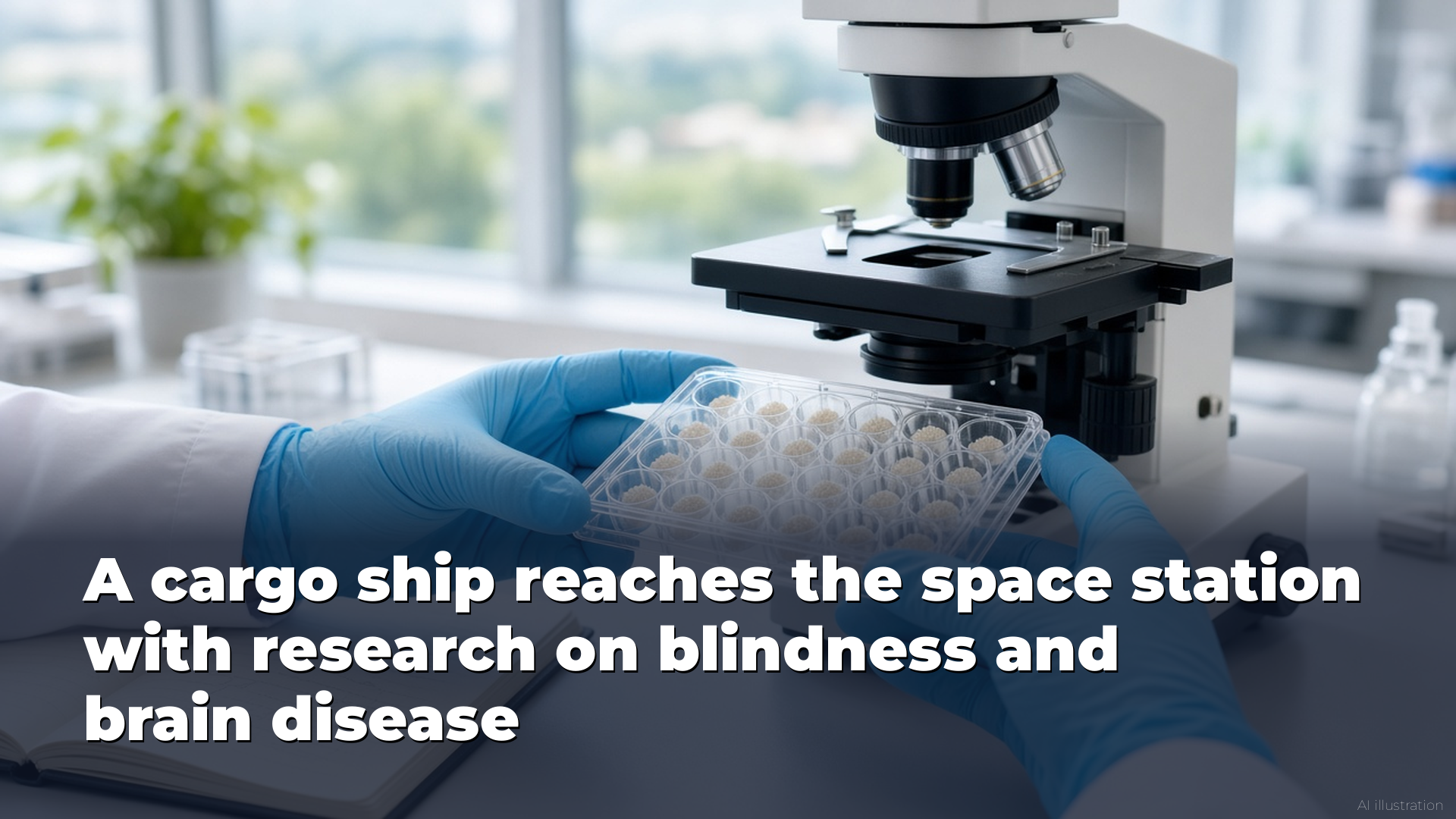
Some of the most hopeful cargo in space this week is not food or fuel, but research that could one day help people who are losing their sight or their memory. A supply ship has just delivered it to the International Space Station (ISS).
Think of a family watching a grandparent struggle with Alzheimer's disease, or a friend whose eyesight is slowly fading. The experiments now on board are aimed, in the long run, at people like them.
The news. A SpaceX Dragon cargo capsule docked to the station at 7:27 a.m. PT (10:27 a.m. EDT) on October 15, NASA said in a blog post. It carried more than 6,300 pounds (about 2,860 kg) of food, supplies and equipment.
What is on board
Artificial retinas. The retina is the thin layer at the back of the eye that senses light. An experiment called LambdaVision-1 will test building artificial retinas one thin layer at a time in microgravity. NASA says this could one day help restore vision for people with retinal diseases that can't be cured today.
Mini brains. An experiment called MINDS uses brain organoids, tiny clusters of brain cells grown in a lab, to study inflammation linked to brain diseases. It mixes cells from several people to better reflect real patients. NASA says it could reveal new treatment targets for Alzheimer's, Parkinson's and multiple sclerosis.
Heart tissue and glass. Dragon also brought 3D heart tissue models to help develop large-scale drug testing on future missions, and materials to study how a new type of glass forms in orbit.
New solar panels. It also carried the last set of new roll-out solar panels for the station, to be installed on spacewalks later this fall.
Why do this in space?
Less settling. On Earth, gravity makes materials sink and settle. NASA says that in microgravity, less settling may let the retina layers form more evenly and stay more stable, which could make the implants work better. Think of stacking thin sheets of paper on a table that never tilts.
Ink, not pencil: this is early research, not a treatment. Results will take time, and NASA's mission pages do not say which companies or labs run the experiments.
Why regular people should care
Eye disease and brain disease touch millions of families. Space research rarely produces a cure overnight, but it can give scientists new ways to study how diseases start and how drugs work. Better lab models of human tissue could help scientists test medicines. For patients and families, that kind of slow, careful progress is often where real hope begins. That is a reason to care about a delivery that arrived about 250 miles (400 km) overhead.
What's next
Home in November. Dragon is set to stay at the station until mid-November, then splash down off the coast of California carrying time-critical research back to scientists. Results from experiments like these usually take months or years to be published, so this is a story to check back on, not a breakthrough to expect next week. The new solar panels, meanwhile, will add power for the station's work.