
By Maya Quill
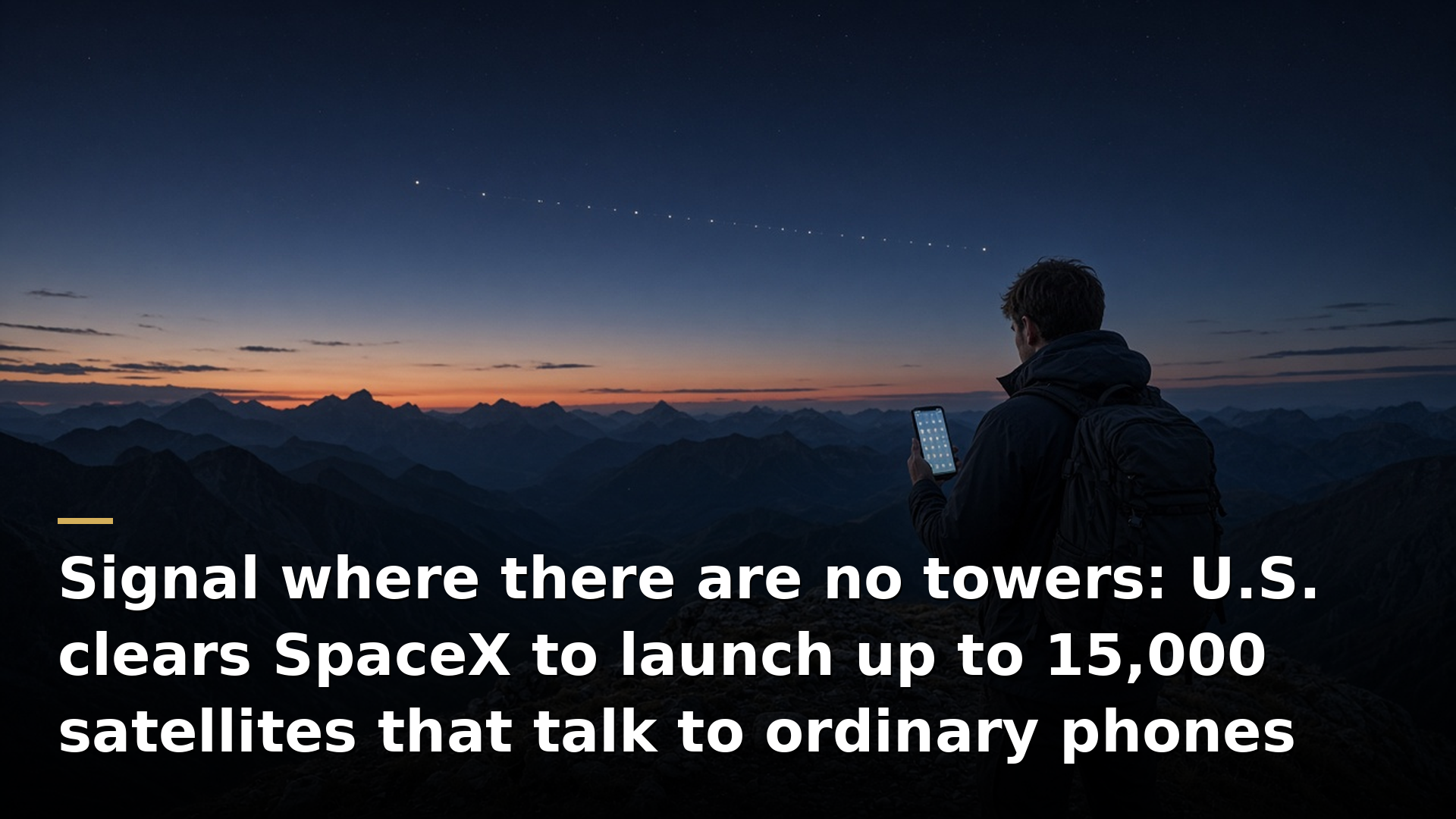
Your phone could one day find a signal, and get a 9-1-1 call through, in places no cell tower reaches. On Oct. 6, the U.S. Federal Communications Commission (FCC) cleared SpaceX to launch up to 15,000 satellites built to connect ordinary phones straight from space, with emergency-call rules written into the approval.
Think of the gravel road two hours past the last town, where the screen shows zero bars. That silence is what this network is meant to fill. It is also years away, and the most exciting numbers are SpaceX's promises, not the government's.
What was approved. The order, issued by two FCC offices that handle satellites and wireless service, lets SpaceX build and run a new network of up to 15,000 satellites for what the industry calls "direct-to-device" service: your regular smartphone, no special antenna. The satellites would fly very low, in nine layers between about 326 and 335 kilometers (roughly 203 to 208 miles) up. SpaceX calls the service Starlink Mobile. It is separate from the Starlink satellites that deliver home internet.
A cell tower on the world's tallest pole. A tower on a hilltop covers only what it can "see." Move that tower into orbit and it can see the highway, the lake, the hiking trail and the farm at once. A small version of this already exists. SpaceX's current phone service runs on roughly 650 satellites, with data speeds estimated at about 4 megabits per second (Mbps). That is fine for texts and slow for much else. In the U.S. it is sold through T-Mobile as T-Satellite, PCMag reports.
The 9-1-1 part is in writing. The order says "public safety is a primary goal" of satellite-to-phone service. Because SpaceX will hold both the satellites and the phone airwaves, the FCC told it to follow the temporary 9-1-1 rules for this kind of service as if it were a regular mobile carrier. In plain terms: emergency calls and texts sent through the satellites must reach a 9-1-1 call center, routed either by the caller's location or through a central emergency call center.
The speed number is SpaceX's goal, not the FCC's. SpaceX is aiming for speeds of up to about 150 Mbps per user on the new satellites, according to PCMag and Light Reading. The FCC did not test or promise that figure. SpaceX President Gwynne Shotwell recently told investors the new system could be "100 times better than what we've got right now," Via Satellite reports.
Bigger satellites need a bigger rocket. The new satellites are larger and need SpaceX's Starship rocket to reach orbit. SpaceNews reports that launches are slated to begin in 2027, while the rocket is still being developed. There is also a paperwork gate. Under the order, SpaceX can't start regular service on the airwaves it is buying from EchoStar until the final step of that deal closes, expected on or about Nov. 30, 2027, according to Via Satellite. It can test before then.
Ink, not pencil: an approval is not a network. The FCC requires SpaceX to have half of the satellites up and working by Oct. 7, 2032, and the rest by Oct. 7, 2035. The 150 Mbps figure is a company target. The 2027 start depends on Starship. The FCC also put off decisions on some of the airwaves SpaceX asked for. And several rival satellite and TV companies, including Eutelsat, Viasat, DirecTV and SES, objected to parts of the plan, mainly over interference with their own satellites, according to the order and Light Reading.
Why regular people should care
Coverage maps have edges. Emergencies don't. Most of us think about signal only when it disappears: the mountain pass, the back road, the campsite, the storm that knocks out a tower. If this network works as planned, the gap between "no service" and "help is coming" gets smaller, especially on highways and in rural areas. It could also change who sells you phone service. The order itself says the plan could eventually bring more competition among the companies that sell mobile service to Americans.
What's next
More airwaves, and a long build. On Oct. 7, a day after the approval, the FCC announced plans to make more airwaves available for satellite-to-phone service. Light Reading reports that a proposal to open an extra 482 megahertz (a measure of airwave space) is set for a vote at the FCC's Oct. 29 public meeting. After that, watch Starship's progress, the first launches of the new satellites, the EchoStar deal's final step in late 2027 and the first real speed tests on real phones. Until then, a call that connects from the middle of nowhere is a plan with a deadline, not a promise.