By Maya Quill
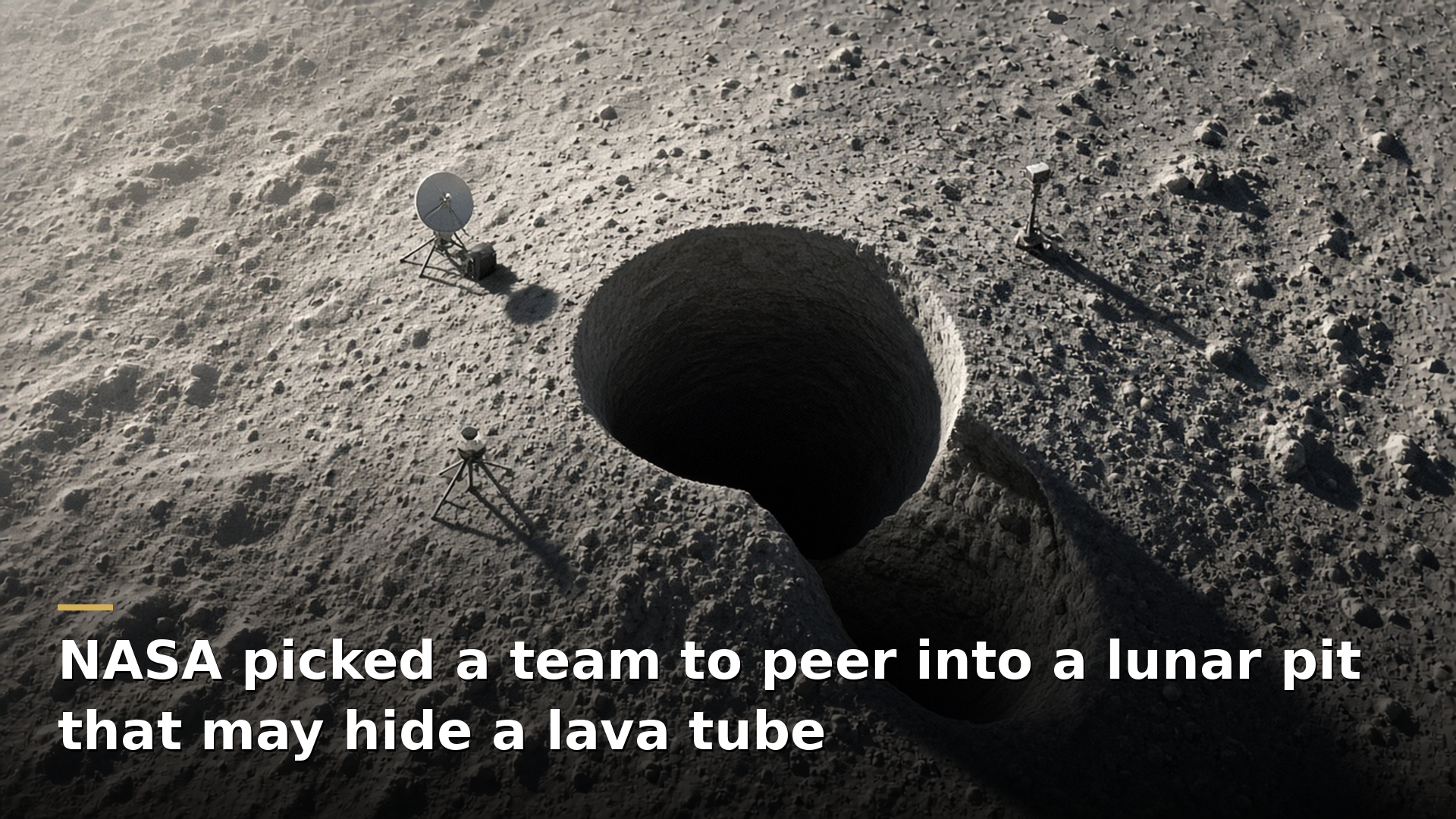
NASA just greenlit a science kit aimed at a hole in the Moon that might open into a natural underground shelter. A Planetary Science Institute–led team was selected under NASA’s Payloads and Research Investigations on the Surface of the Moon (PRISM) program for GIMLI — Geophysical Instruments for Marius Lunar pit Investigation — to test whether the Marius Hills pit leads into a lava-tube void.
Why a pit matters. Orbital images already hint that caves and lava tubes may sit under the lunar surface. A confirmed tube could shield future crews from radiation and extreme temperature swings — ready-made cover instead of hauling every wall from Earth. NASA’s own release frames the same idea: natural underground spaces as thermal stability and radiation shielding for long-term living.
What flies. GIMLI will use ground-penetrating radar (from the Norwegian Space Agency), active-source seismic sensors, a gravimeter, and cameras to look for a void extending from the pit and, if one exists, help size it. Honeybee Robotics — a Blue Origin company — will provide project management and build most of the instrumentation (active-source seismic, gravimeter, and cameras), integrate the gear onto a Commercial Lunar Payload Services (CLPS) lander and rover, and help operate it on the surface with PSI.
A seismic first since Apollo — if it flies as planned. Principal investigator Than Putzig (PSI) notes the team wants to reintroduce intentional active-source seismic methods to planetary science, essentially unused since Apollo astronauts ran the first lunar seismic surveys. Pairing that with radar and gravity is the bet for a clearer subsurface picture.
Science even if the cave isn’t there. If no tube shows up, the data can still probe how the pit formed, map nearby geology and volcanic history, and study layers of regolith and lava exposed in the pit walls. Co-investigators include teams from Boise State, Johns Hopkins, the Lunar and Planetary Institute, and the University of Oslo.
Ink, not pencil: selection is not a launch. The primaries do not name the lander, a launch date, or a mission year. Treat GIMLI as a funded investigation queued for a future CLPS delivery — schedule TBD.
Why regular people should care
The Monday stake is shelter. Living on the Moon means surviving radiation and night-and-day temperature swings. If a lava tube is real and reachable, habitat planning can lean on geology instead of only on metal cans — a quieter, more abundant path to staying longer.
What's next
Watch which CLPS provider and lander get assigned, when integration and operations plans firm up, and whether companion PRISM payloads (NASA also named LEMS-SP and DISCO in the same selection round) move on similar clocks. Until a flight is dated, the news is the science pick — not a countdown.