
By Maya Quill
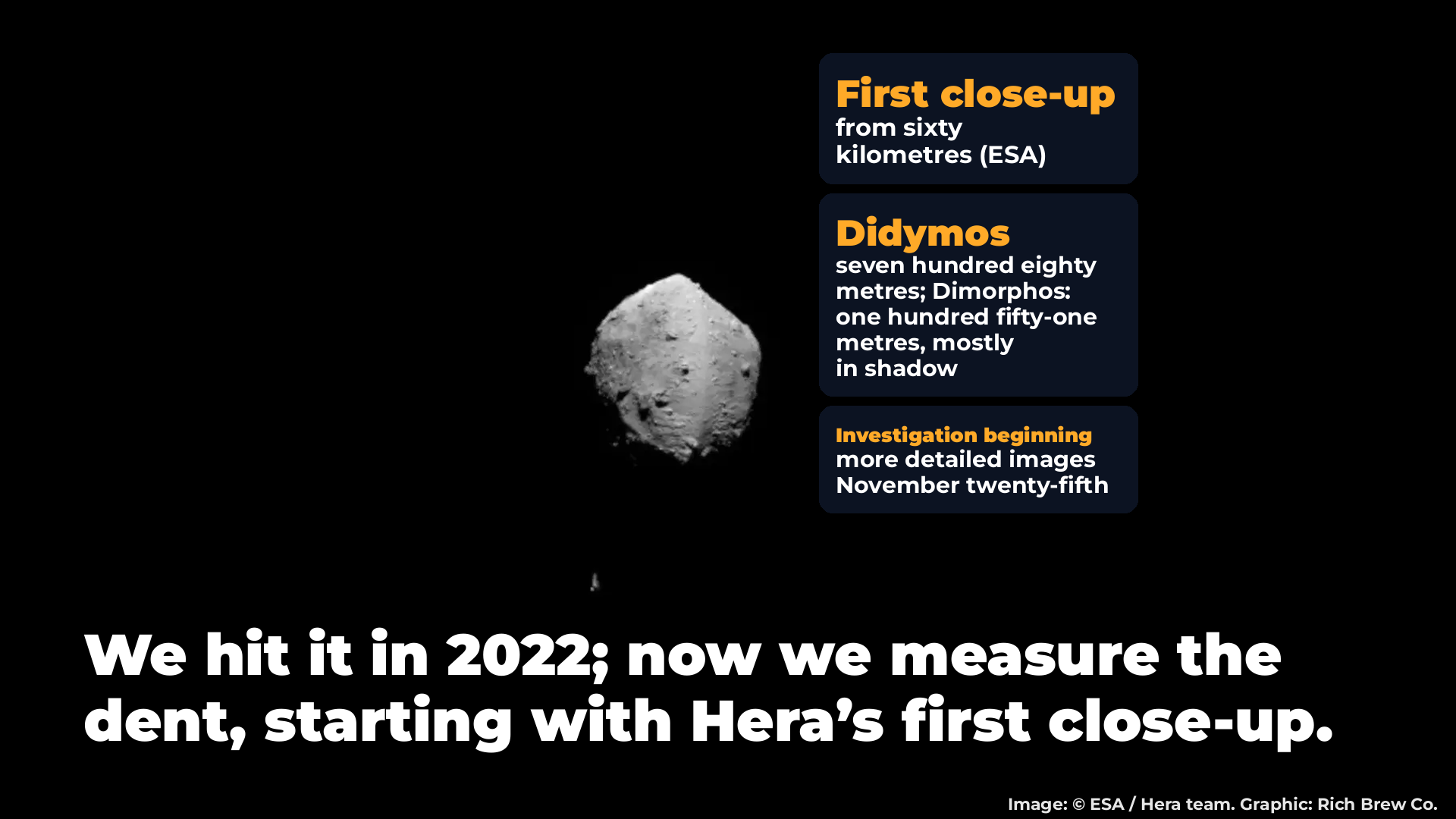
We hit an asteroid’s moonlet in 2022. Now a second spacecraft is getting close enough to investigate what changed. For anyone hoping Earth will have a tested way to deflect a dangerous space rock, this is the follow-up that makes the experiment more useful.
It is like checking a dent after a crash test: seeing that something moved is only the start of understanding how it responded.
A new view of two space rocks
In a November 5 release, ESA [European Space Agency] shared Hera’s first close-up of the Didymos asteroid system. Its monochromatic Asteroid Framing Camera took the image from 60 kilometres away.
The 780-metre-wide parent asteroid, Didymos, appears clearly. Most of its 151-metre moonlet, Dimorphos, is hidden in shadow. This is a new view of the system, not a completed map of the impact site.
“The first thing we said was wow!” said principal investigator Patrick Michel in ESA’s release. He explained that Hera sees the other side of Didymos from the one photographed just before the impact. Alongside its central equatorial ridge, the image shows boulders, craters and apparent grooves or ridges.
Mission scientist Michael Kueppers said material thrown off Dimorphos may have travelled to Didymos and helped create some features. That is a possibility to investigate, not a settled explanation.
Why the impact needs a follow-up
NASA [National Aeronautics and Space Administration] struck Dimorphos on September 26, 2022, with DART [Double Asteroid Redirection Test]. ESA describes a 580-kilogram spacecraft travelling at about 6.1 kilometres per second.
The collision shortened the moonlet’s orbit around Didymos by 33 minutes, give or take a minute—a larger change than predicted, according to ESA. Hera’s job is to help explain that response and make impact-based deflection better understood and potentially repeatable.
Ink, not pencil: Hera has delivered a first close-up; it has not already mapped the impact crater or finished its investigation.
Why regular people should care
Planetary defence is preparation for a shared risk. The useful result is not just a striking photograph: it is better knowledge of how a real asteroid reacts when pushed. That knowledge could inform future protection efforts if Earth ever needs them.
What's next
ESA says detailed images of both asteroids will be unveiled on November 25. The team’s close-up investigation and mapping work lie ahead; this first view opens the case rather than closes it.