
By Maya Quill
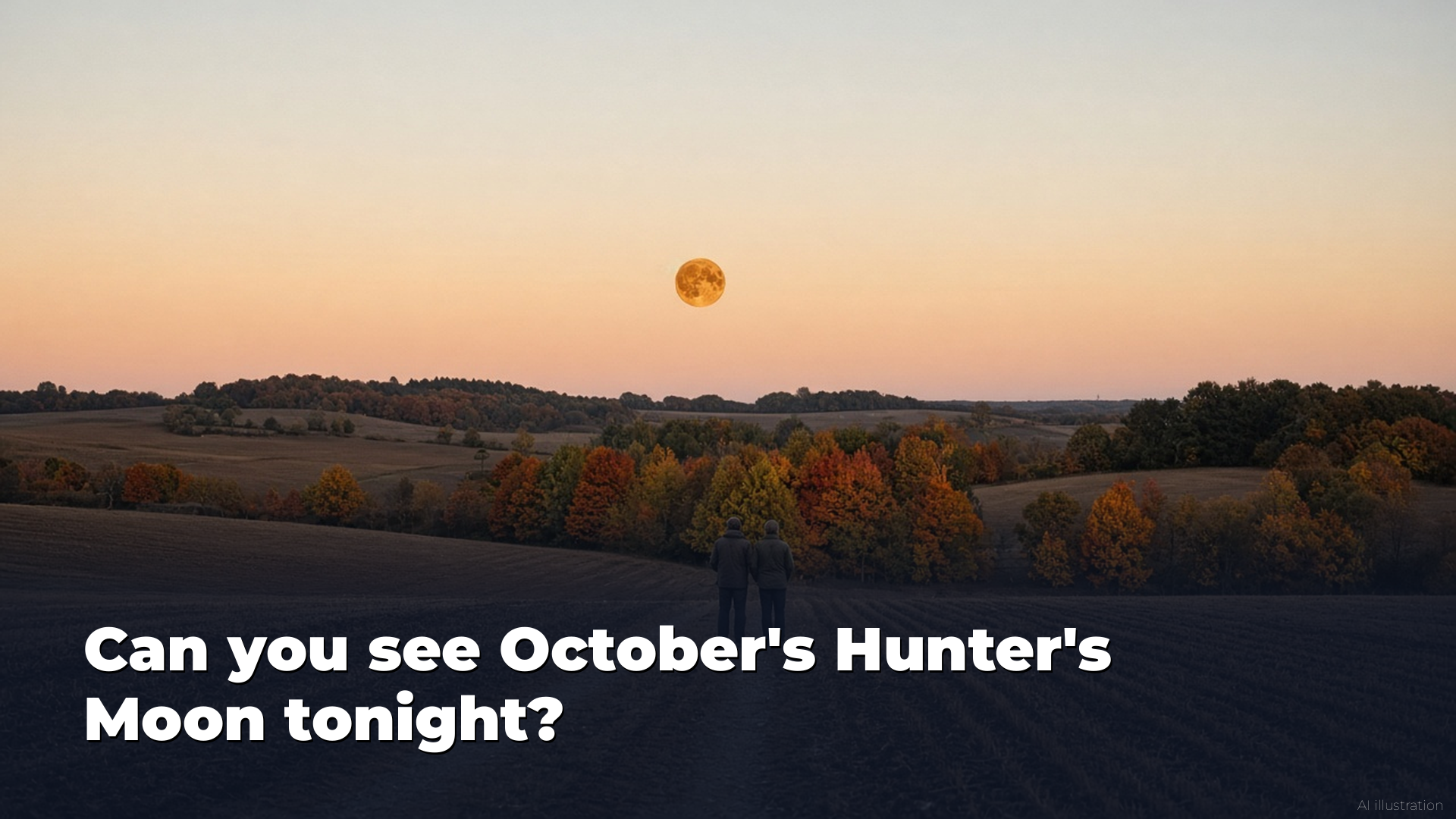
Some of the best things in life cost nothing and take five minutes. Tonight, and again on Monday evening, one of them is right above your street.
October's full Moon, the Hunter's Moon, is here. You do not need a telescope, an app or a dark field in the countryside. You need a clear view to the east around sunset, and maybe a warm jacket.
When to look
The Moon becomes exactly full at 12:11 AM Eastern Time on Monday, October 26, according to timeanddate.com. That is 9:11 PM Pacific Time (PT) on Sunday, October 25, or 04:11 in Universal Time. (Astronomy magazine lists it one minute later, at 12:12 AM Eastern.)
You do not have to catch that exact minute. To our eyes, the Moon looks full for around three days, Astronomy magazine says. On Monday evening it will still be about 99% lit, according to Astronomy magazine's figures.
The easy plan:
- At sunset, face east or southeast. A full Moon rises as the Sun sets, because it sits on the opposite side of the sky from the Sun, BBC Sky at Night Magazine explains.
- Around midnight, it will be high in the south (if you live in the Northern Hemisphere).
- Before dawn, it sets in the west.
On Monday the Moon rises a little later than on Sunday, so give it some extra minutes after sunset.
Is it a supermoon?
No. A supermoon is a full Moon that happens when the Moon is near its closest point to Earth. The next two supermoons of 2026 come on November 24 and December 23 (Eastern Time; December 23 is also the date in Pacific Time), according to Astronomy magazine.
Here is a fun detail, though: the Moon reaches its closest point this month on Wednesday, October 28, at 226,433 miles (364,409 kilometres) away, Astronomy magazine says. It just misses lining up with the full Moon.
Why it looks so big near the horizon
When the full Moon first rises, it can look huge and orange, Sky at Night notes. The colour is real: its light passes through more air near the horizon, the same reason sunsets look orange. The size is mostly a trick of the eye. The Moon is not really bigger. A simple test: hold your thumb at arm's length beside the rising Moon, then try again when it is high up. It covers about the same amount.
Where the name comes from
In the Northern Hemisphere, people once spent October getting ready for winter by hunting and preserving meat, timeanddate.com explains. The bright Moon gave them extra light after dark, so it became the Hunter's Moon, an old Anglo-Saxon name later used in the Farmer's Almanac in North America.
Native American peoples had their own names for this Moon, taken from what happens in the fall, such as Drying Rice Moon, Falling Leaves Moon and Freezing Moon.
Picture a family long ago, finishing the day's work by moonlight because there were no streetlights. For most of human history, a full Moon was the only "lamp" in the night sky.
Ink, not pencil: the Moon is full at 9:11 PM PT on Sunday, October 25, and it is not a supermoon. Clouds are the only thing that can take it away from you.
A few simple tips
- Phone photos: tap the Moon on your screen, then slide the brightness down so it is not a white blob. Rest your phone on something steady.
- With binoculars or a small telescope, look for the bright streaks around the crater Tycho near the Moon's bottom edge. Astronomy magazine says these "rays" show up well at full Moon.
- Too bright? Astronomy magazine suggests sunglasses can help cut glare at the telescope eyepiece.
Why regular people should care
It is free, everyone on the night side of Earth can share it, and it is a quiet reason to step outside, look up and breathe. In a busy week, five minutes with the Moon is a small, real gift.
What's next
The Moon will shrink a little each night after Monday. The next full Moon, the Beaver Moon on November 24, will be a supermoon, so mark the calendar.