
By Maya Quill
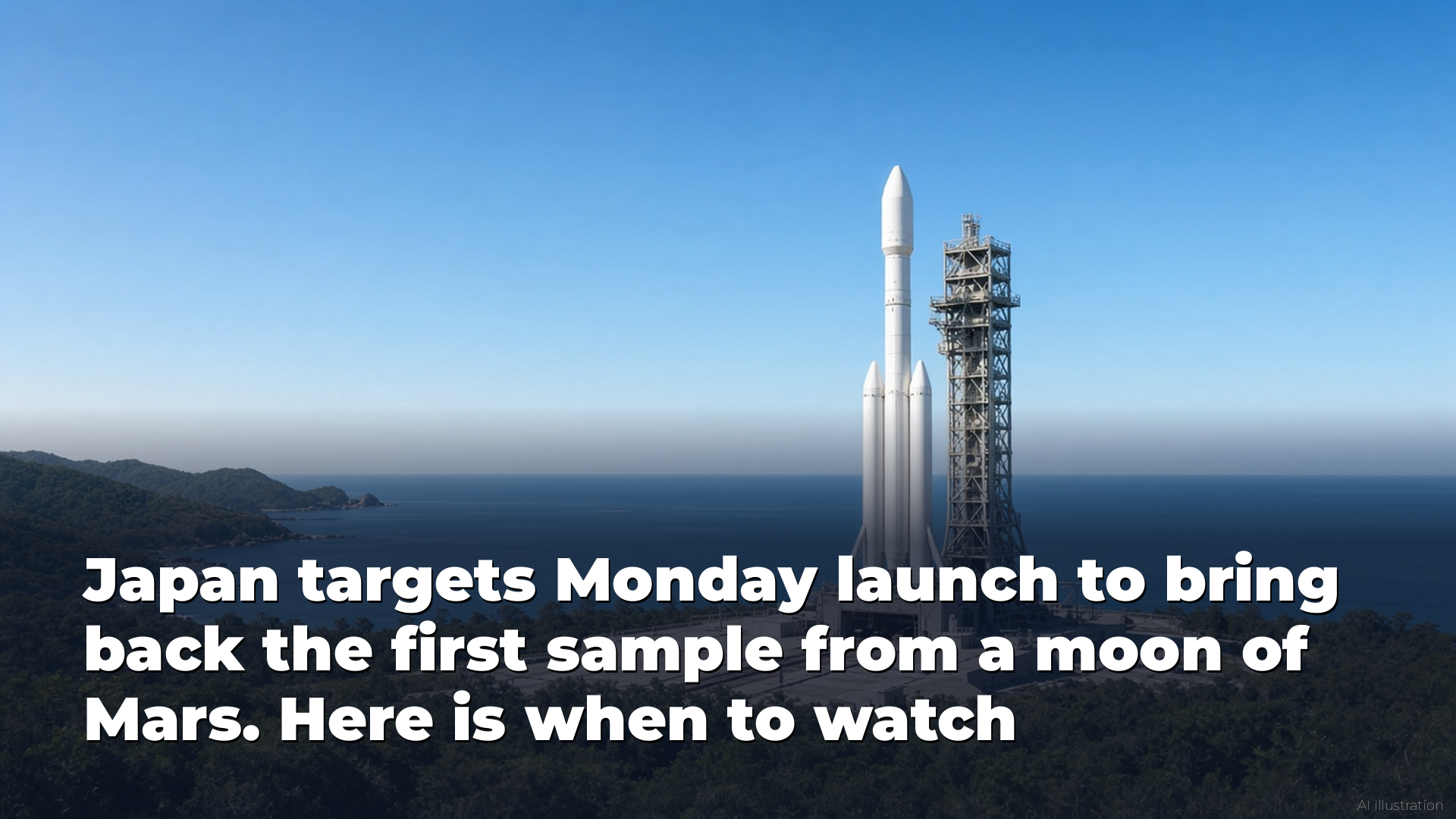
Where did the water on Earth and Mars come from? It sounds like a simple question, but nobody knows the full answer. On Monday, Japan plans to launch a spacecraft that could bring back a clue from a place no one has ever sampled: a small moon of Mars.
The news. The Japan Aerospace Exploration Agency (JAXA) is targeting launch of its Martian Moons eXploration (MMX) spacecraft on its H3 rocket. It will lift off from Tanegashima Space Center in southern Japan. JAXA's launch notice, dated October 18, sets the time at 04:41:03 Japan Standard Time on Tuesday, October 20.
When to watch
Monday, October 19: 12:41 p.m. Pacific Time, or 3:41 p.m. Eastern Time. That is 19:41 Coordinated Universal Time (UTC). In Japan, it is already early Tuesday morning.
Where: The European Space Agency (ESA) says the launch will stream live in Japanese and English on JAXA's YouTube channel.
If it slips: Launch dates can slip because of weather or technical checks. JAXA has a backup window from October 21 to November 9. It says the launch time may change within that window.
The plan
Mars has two small moons, Phobos and Deimos. Phobos is the larger one. Scientists still do not know where they came from. They may be asteroids that Mars captured. Or they may be debris thrown into space when something huge smashed into Mars.
JAXA leads the mission. Its partners are NASA, France's space agency CNES, the German Aerospace Center (DLR) and ESA. According to ESA, the planned timeline is:
- August 2027: arrive in orbit around Mars, then orbit Phobos from September 2027.
- Early 2029: drop a 25-kilogram rover called Idefix onto Phobos.
- 2030: land on Phobos to collect samples.
- 2031: send at least 10 grams of Phobos material back to Earth in a capsule that lands in Australia.
Ten grams is about the weight of two U.S. nickels. Gravity on Phobos is so weak that ESA says the rover will weigh the equivalent of just 15 grams there. That is about three sheets of printer paper on Earth.
Why regular people should care
The big questions are about our own origins. In its mission press kit, JAXA says MMX will analyse hydrated minerals, water and organic matter. The goal is to learn how water and the building blocks of life moved through the early Solar System and reached planets like ours.
"The data and samples returned by MMX are a window to study the evolution of Mars and the Solar System," says Elliot Sefton-Nash, ESA's MMX project scientist.
There is a practical side, too. MMX would be the first mission to visit the Mars system and come back. ESA says that kind of round trip could help future missions bring samples back from Mars itself. It could perhaps one day help people visit Mars. Get there, pick something up, come home.
Ink, not pencil: Monday is a target, not a promise, and every date after launch is a plan that can change.
What's next
Launch, then a long trip. If all goes well, ESA says it will release images on October 20 confirming the launch. After that, MMX takes about a year to reach Mars. If you tune in Monday, you will see the first step of a journey that is planned to end in Australia in 2031.