
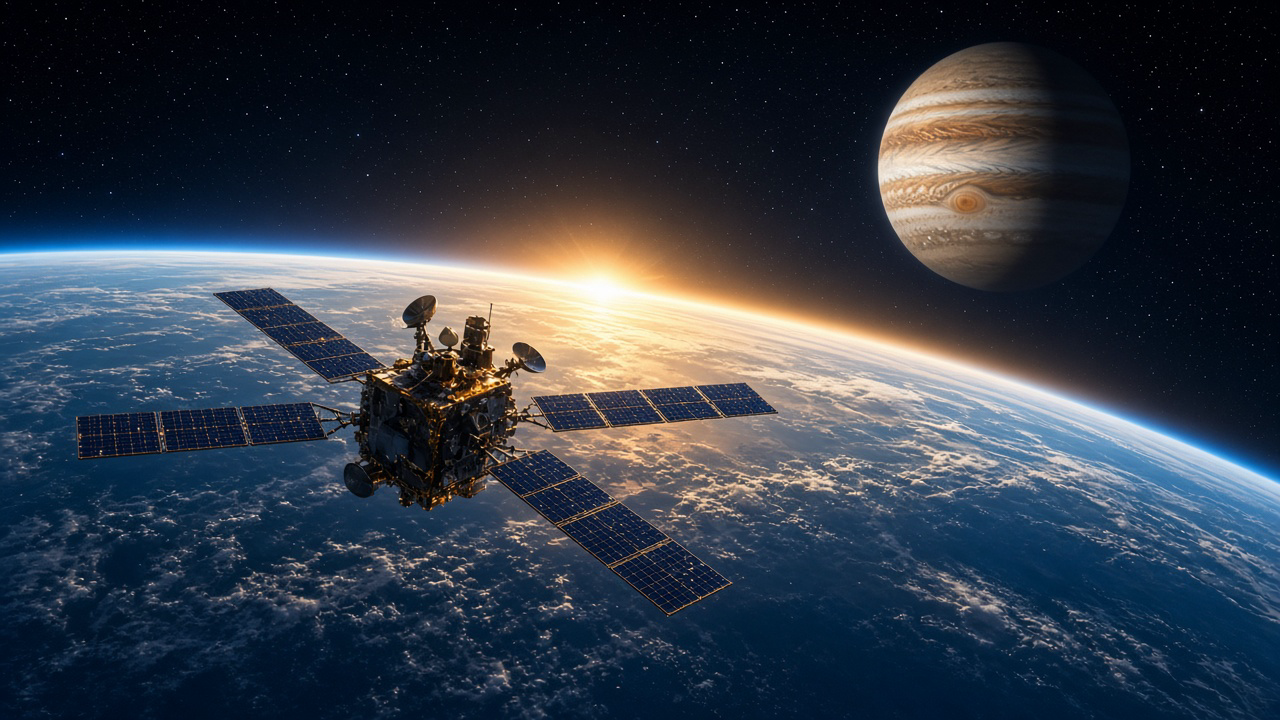
On a Monday morning over the Indian Ocean, a spacecraft the size of a bus brushed past our planet — not to come home, but to steal a little momentum and keep going. ESA’s Jupiter Icy Moons Explorer, Juice, made closest approach about 8,640 km above Earth on Sept. 28, 2026. Gravity did the heavy lifting: the flyby bent Juice’s path by roughly 20° and added about 3.5 km/s of speed — around 8,000 mph — with almost no propellant spent.
That free boost matters more than it sounds. Without gravity assists from Earth, Venus, and the Moon, reaching Jupiter would eat a fuel budget Juice needs later. ESA and Space.com both underline the point: fuel saved now is fuel for entering Jupiter orbit around 2031, then hopping toward Ganymede a few years after. The mission’s science targets are the big ocean-bearing moons — Europa, Ganymede, and Callisto — places where liquid water may hide under ice, and where questions about habitability get serious.
Earth was not only a slingshot. It was also a calibration bench. Juice’s ten science instruments got a rare chance to practice on a well-understood world — magnetotail measurements, camera work, the whole checklist — before the harder dozens of flybys of Jupiter’s moons. Operators used only a tiny planned nudge beforehand; most of the reserved propellant stayed in the tank. And this was not the last goodbye: Juice is scheduled for another Earth flyby in January 2029, the final slingshot onto its track to Jupiter.
Why it matters
Most of us will never fly past Jupiter. We do live on the planet that just lent its gravity to a probe hunting for clues about whether icy moons could host life. A mission that arrives with fuel left for science — not just for getting there — is the difference between a fly-through and a real investigation. Wonder, with a practical receipt: careful navigation, saved propellant, and instruments warmed up on home turf.
What’s next
Images and spectra from the flyby should roll out in the coming weeks as instrument teams finish their checks. Then the long cruise continues toward that 2029 Earth encounter and Jupiter arrival around 2031 — with Ganymede rendezvous still further down the road. For now, Juice is on a better course, carrying a little more of Earth’s momentum and a lot more of our curiosity.
Sources: - Successful Earth flyby improves Juice’s course to Jupiter (ESA) - Jupiter-bound JUICE spacecraft just got an 8,000 mph speed boost from Earth (Space.com)