
By Maya Quill
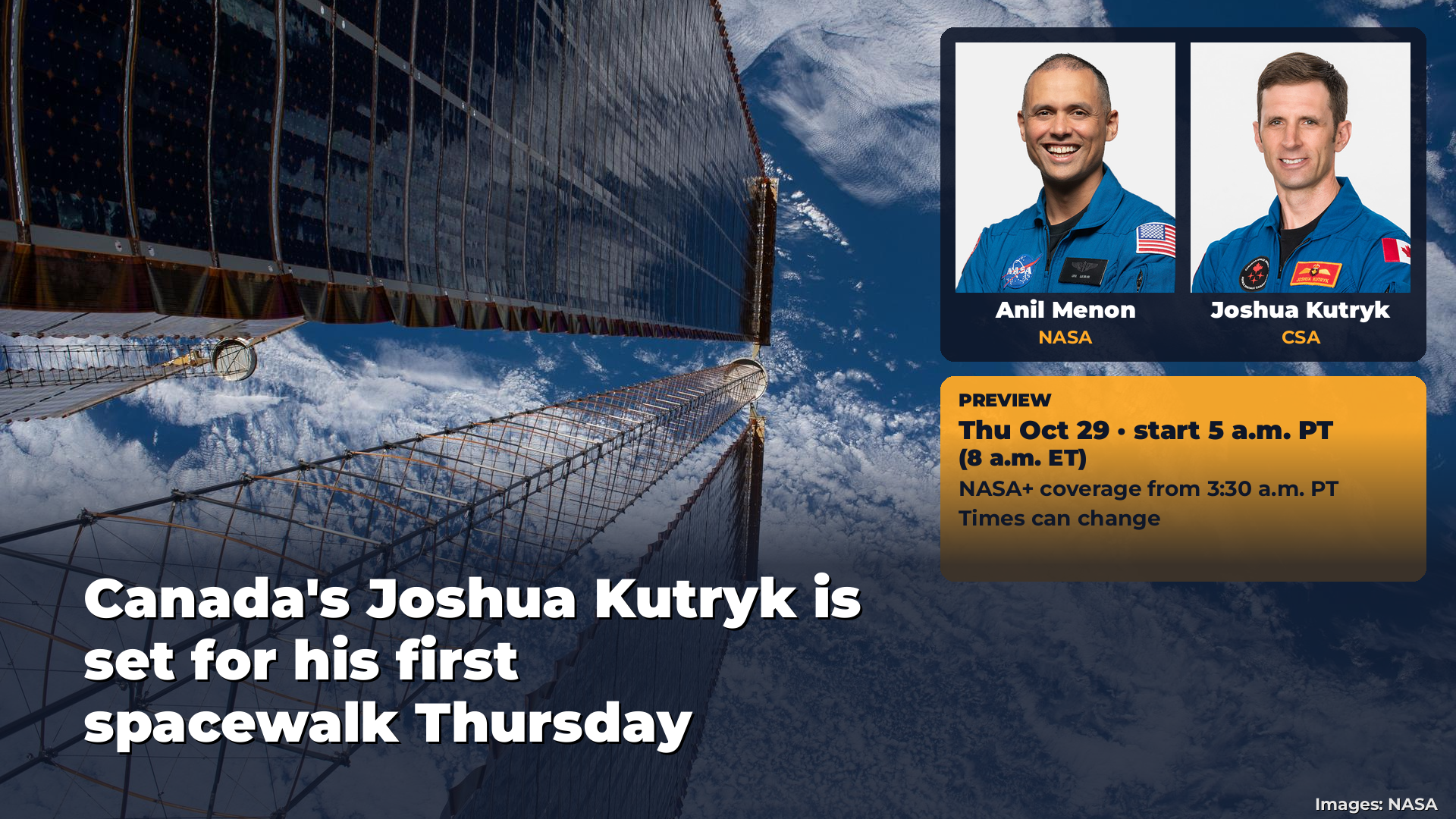
Images: NASA. Background: roll-out solar arrays, March 18, 2026 spacewalk; inset: Anil Menon (left) and Joshua Kutryk.
Early Thursday morning, while many of us are still asleep or making the first coffee, a Canadian will open a hatch on the International Space Station and step outside into space for the first time. If you are up early, you can watch it live. Here is what is planned, when, and why it matters.
The plan
On Wednesday, October 28, NASA's mission managers gave the go for a spacewalk on Thursday, October 29, according to NASA's space station blog.
- Who: Joshua Kutryk of the CSA (Canadian Space Agency) and Anil Menon of NASA (National Aeronautics and Space Administration).
- When: the spacewalk is set to start at 5 a.m. Pacific Time (8 a.m. Eastern). NASA+ live coverage begins at 3:30 a.m. PT (6:30 a.m. ET).
- How long: about six hours and 45 minutes.
Ink, not pencil: spacewalk times often move, sometimes at the last minute, for safety or technical reasons. Check NASA+ or the CSA before you set an alarm.
What they will do
The job is to add a new solar panel, called a roll-out solar array. It travels rolled up, like a yoga mat, and then unrolls in space to catch sunlight.
NASA describes the steps:
1. The two astronauts unbolt the rolled-up array from a temporary storage spot. 2. Menon carries it to the worksite while riding Canadarm2, the station's Canadian-built robot arm. 3. Kutryk moves across to the same spot, clipped to the station by a safety tether, and joins Menon to fit it. 4. Flight controllers on the ground then switch the array on so it starts making power.
Inside, NASA astronauts Jessica Watkins and Luke Delaney will operate Canadarm2 and keep watch through the station's cameras.
A big day for Canada
According to the Canadian Space Agency, Kutryk will be the fifth Canadian astronaut to walk in space, after Chris Hadfield, Steve MacLean, Dave Williams and David Saint-Jacques. Spaceflight Now notes he would be the first since Saint-Jacques in 2019.
Kutryk, a colonel in the Royal Canadian Air Force and a test pilot, arrived at the station on October 1 with SpaceX's Crew-13 mission. For Menon, Spaceflight Now says, it will be his fourth spacewalk.
Canada has more than one seat at the table. The CSA says Canadian astronaut Jenni Gibbons will be capcom, the main voice linking the crew with experts on the ground, from NASA's Johnson Space Center in Houston. CSA teams in Longueuil, Quebec, designed the robot arm's moves for this job and will support it live.
Picture it: your first day doing the hardest task of your career, in a bulky suit, holding on with gloved hands, while your teammates move a robot arm around you, and your country watches.
Why the station needs more power
The station's original solar wings have been in the sun for more than 20 years and slowly make less power, the way an old phone battery holds less charge. The new arrays are mounted in front of the old ones, so the uncovered parts of the old wings keep working, Spaceflight Now explains. The CSA says the panels from this spacewalk and the next one, together with earlier ones, will increase the station's power by up to 30%.
Why regular people should care
More power means more room for the science done on the station, much of it aimed at life back on the ground. It is also simply a hopeful thing to watch: people from two countries, plus a robot arm, working carefully together far from home.
What's next
If all goes to plan, the CSA says Kutryk and Menon will head out again on November 5 to install another new array; Spaceflight Now reports it will be the eighth and final one in an upgrade that began in 2021. The CSA says Kutryk will speak with Canadian media from the station on October 30. We will update with how Thursday went.