
By Maya Quill
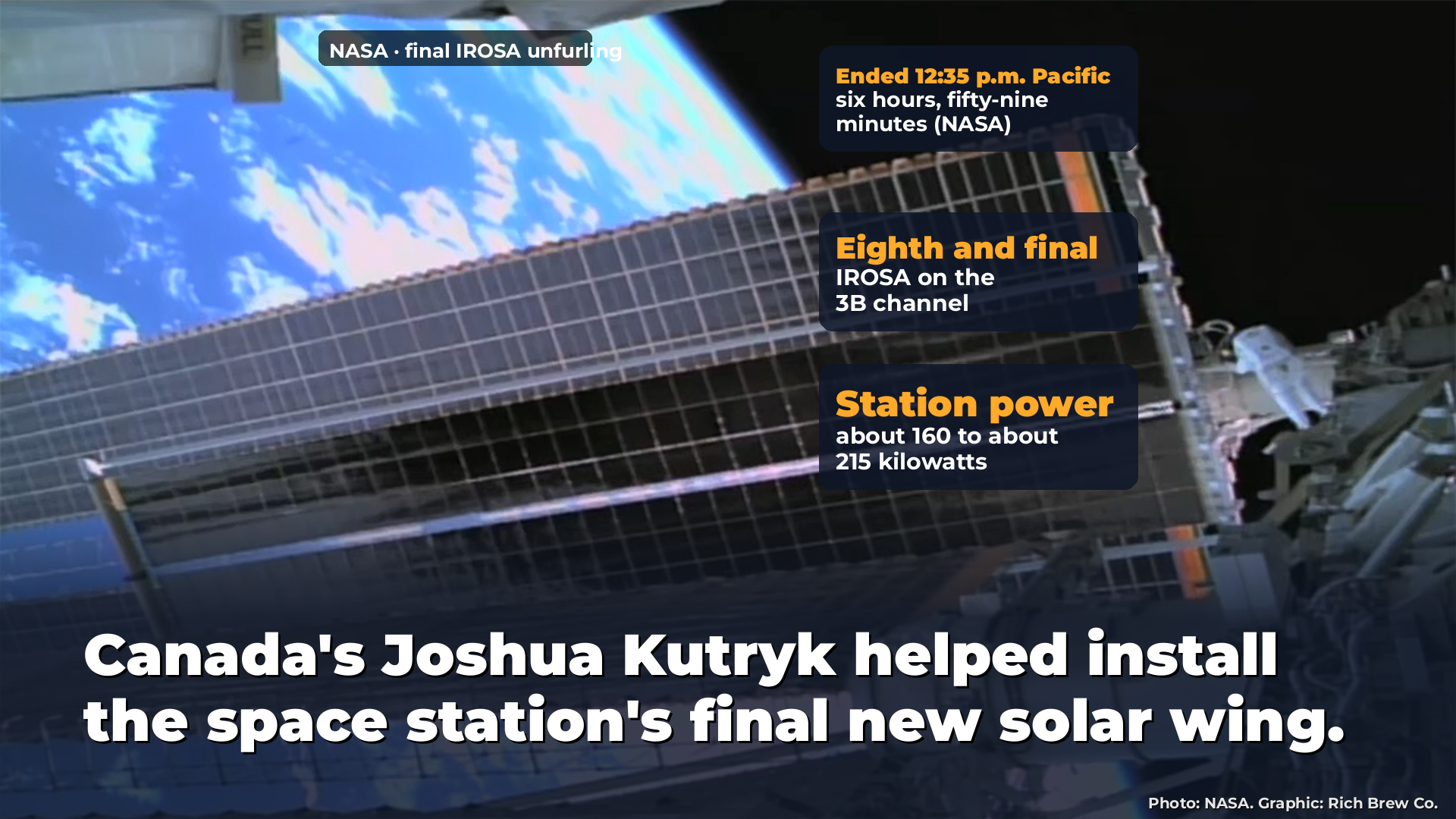
Imagine climbing outside a building hundreds of kilometres above Earth to bolt on a new power panel. That is roughly the job Canadian Space Agency (CSA) astronaut Joshua Kutryk and NASA astronaut Anil Menon completed Thursday outside the International Space Station (ISS).
What NASA confirmed
According to NASA's 3:52 p.m. Eastern update, Kutryk and Menon concluded the spacewalk at 3:35 p.m. Eastern time, which is 12:35 p.m. Pacific time. The outing lasted six hours and 59 minutes. They had begun at 8:36 a.m. Eastern time (5:36 a.m. Pacific), per NASA's earlier start post. Kutryk was spacewalk crew member 1, in the suit with red stripes. Menon was crew member 2, in the unmarked suit.
What they installed
NASA says the duo installed and deployed the eighth and final International Space Station Roll-Out Solar Array, or IROSA, on the station's 3B power channel, completing the power-augmentation upgrades. A November 4 NASA blog said the work was on the far end of the starboard (right-hand) truss. NASA says the roll-out arrays raise the station's generating capacity from about 160 kilowatts to about 215 kilowatts.
On the station, that extra power means more room for science and systems.
Who did what
NASA said the plan largely repeated the pair's October 29 spacewalk, but on the opposite side of the truss. Menon rode the Canadarm2 robot arm while carrying the rolled-up array; Kutryk met him at the worksite, exchanged the array, and helped finish the install. The Canadian Space Agency notes this was Kutryk's second spacewalk, one week after a similar outing on October 29 that lasted seven hours and 11 minutes. The CSA says that puts him alongside Chris Hadfield, Steve MacLean, Dave Williams and David Saint-Jacques as Canadian spacewalkers. NASA says Thursday's outing was U.S. spacewalk 101 — Menon's fifth and Kutryk's second — and the 286th spacewalk in support of the station.
Ink, not pencil: NASA confirms the spacewalk started at 5:36 a.m. Pacific time, ended at 12:35 p.m. Pacific time, lasted six hours and 59 minutes, and that the crew installed and deployed the eighth and final roll-out solar array on the 3B channel.
Why regular people should care
More station power is not an abstract engineering win. It is what keeps experiments running, like the microbe samples and lung-cell research the crew worked on this week. For Canadian readers, it is also a live human moment: a CSA astronaut working outside, with Canada's robot arm in the mix.