
By Maya Quill
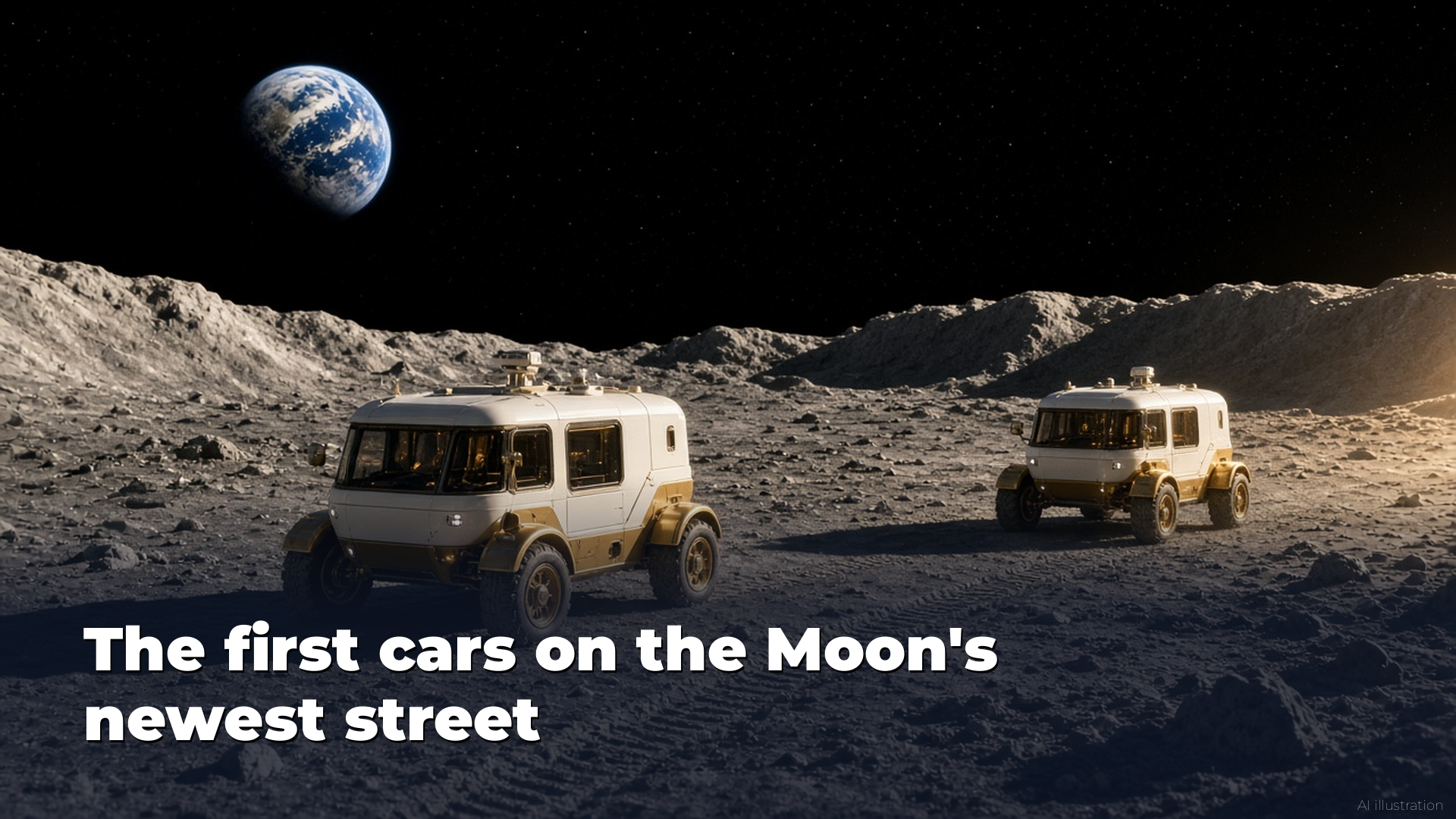
Nobody moves into a neighbourhood that has no roads. On the Moon, the first residents won't be people at all. They will be cars.
Think of a new subdivision. Long before the first family unpacks a box, crews pour roads, run power lines and sort out deliveries. The houses come last. The Moon is following the same order.
The people who just came home. It helps to start with the humans. On April 1, 2026, four astronauts left Earth on Artemis II: Reid Wiseman, Victor Glover and Christina Koch of NASA (the National Aeronautics and Space Administration), and Jeremy Hansen of the Canadian Space Agency (CSA). They flew around the Moon and splashed down on April 10, according to NASA's mission page.
A base, not a visit. NASA calls the plan Moon Base, and it is aimed at the lunar South Pole. On May 26, NASA Administrator Jared Isaacman described it this way: "The Moon Base will be America's and humanity's first outpost on another celestial world." Apollo was a series of visits. This is meant to be a place people return to.
Meet the first two cars
On the same day, NASA announced the companies building the first Lunar Terrain Vehicles (LTVs), rovers that astronauts can drive. NASA awarded Astrolab $219 million and Lunar Outpost $220 million for the first phase.
Astrolab's rover is the pickup truck. It is called the Crewed Lunar Vehicle, or CLV-1. NASA describes it as a crewed rover "designed to transport astronauts, carry supplies, and support remote operations." It folds up small for the trip, weighs about 2,000 pounds (about 900 kilograms) and can go more than 6 miles per hour (about 10 kilometres per hour) on flat ground.
Lunar Outpost's rover is the one that keeps working when nobody is home. It is called Pegasus. NASA says it can operate for up to a year and is capable of "manual, autonomous, or teleoperated driving." In plain words: an astronaut can drive it, it can drive itself, or someone can steer it from far away. It can reach more than 9 miles per hour (about 14 kilometres per hour) and "incorporates Apollo-heritage technologies."
Why two? NASA says putting several rovers down early will help it map hazards, move materials and "pre-stage resources" before crews arrive, like a work crew dropping off lumber before the builders show up.
Over the next 18 months, according to NASA, both companies will finish their designs, test them with crews and get flight versions ready.
The delivery truck
A car is no use on a street it can't get to. To carry the rovers to the South Pole region, NASA awarded Blue Origin $188 million, with an option period worth $280.4 million. NASA's Moon Base phases page says Blue Origin will deliver both rovers to the Moon in 2028, and its Blue Moon Mark 1 lander is part of the first phase of the base.
Deliveries are already lining up. NASA says the first Moon Base mission, targeted for no earlier than fall 2026, will use a Blue Moon Mark 1 lander to test landing on a ridge near Shackleton crater. The goal is to reduce risk for crewed Artemis landings that NASA has planned for 2028.
Ink, not pencil: every date here is a target, not a promise. Space hardware runs late more often than it runs early, and contract values and options can change as the work moves along.
The whole street, in three phases
NASA has laid out the base in three steps. From now to 2029, robots explore, test and learn. From 2029 to 2032, the first power, cargo and communications systems arrive. From 2032 on, the plan is a lasting outpost where astronauts can live and work for long stretches.
A camper for the Moon. The Japan Aerospace Exploration Agency (JAXA) is supplying a pressurized rover. NASA asks, "What if astronauts could bring their habitat on the road with them?" It is a camper van, but for a place with no air.
The plan has already changed shape. In March, NASA said Artemis III, scheduled for 2027, will test systems in Earth orbit instead of landing, and that the first landing comes with Artemis IV. NASA also said it intends to "pause Gateway in its current form," the planned station around the Moon, and put its effort into the surface. Paused is not cancelled.
Why regular people should care
This is how big things actually get built. Not in one heroic leap, but in boring, essential order: roads, deliveries, power, then homes. The rovers that learn to drive themselves on the Moon's rough, dark ground are solving problems that matter on Earth, too. And a Canadian astronaut has already flown around the Moon and back. This neighbourhood already has a crew list.
What's next
Watch the deliveries. NASA says more than a dozen Moon Base missions will be announced this year. Over the next year and a half, CLV-1 and Pegasus move from designs to flight hardware. If those first robot trips go well, the first cars on the Moon's newest street could be parked and waiting when the first astronauts step out in 2028.