
By Maya Quill
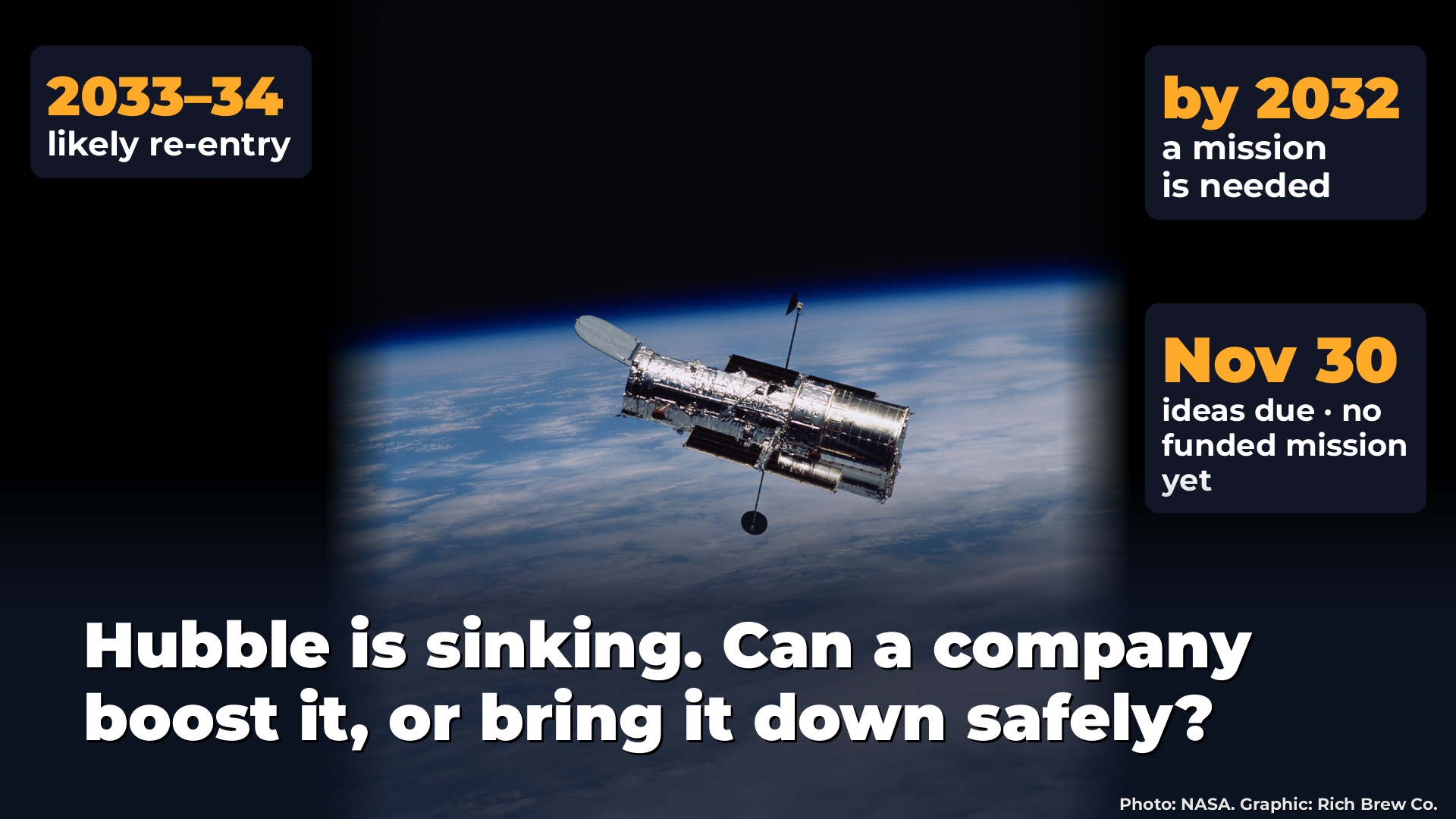
If you have ever seen a glowing space picture on a classroom wall, there is a good chance it came from the Hubble Space Telescope. Hubble is still working, but it is slowly sinking toward Earth, and it has no engine to climb back up. Now NASA has asked companies a simple question: can any of you help? It is an open, hopeful question with a real deadline.
What happened
On Thursday, October 29, NASA issued a request for information (RFI), a formal way of asking industry, "tell us what you could do." It is not a contract. NASA's announcement, posted Friday, says it wants to hear about three options:
- Boost Hubble to a higher orbit, to extend its science life.
- Service Hubble, to improve what it can do.
- Bring it down safely, with a controlled re-entry into the atmosphere, or another safe disposal at the end of its mission.
The notice on SAM.gov, the US government's contracting website, adds details. A boost would need to capture Hubble and lift it to at least 600 kilometres (about 373 miles) up. Any mission "must not harm" the telescope. The company would supply the rocket, the spacecraft and, if needed, the crew. NASA would provide technical help from its Hubble experts.
Responses are due by 3 p.m. Eastern time on Monday, November 30 (noon Pacific time).
Why Hubble is sinking
Hubble circles Earth in low orbit, now about 470 kilometres (292 miles) up, Ars Technica reports, where a very thin trace of air still drags on it. Think of a bicycle coasting on a flat road: if no one pedals, it slowly loses speed. Hubble has no propulsion system to "pedal" itself back up, NASA says.
NASA's analysis predicts Hubble will likely re-enter the atmosphere between 2033 and 2034, so any mission would need to happen by 2032. The SAM.gov notice says a July 2026 analysis found a 10% chance of re-entry by September 2032, and a 50% chance by December 2033. Without help, it says, Hubble "will ultimately experience an uncontrolled reentry."
Ink, not pencil: this is a request for ideas, not a rescue plan. NASA says the RFI is not a commitment, and Ars Technica reports that NASA does not currently have money set aside for a boost or servicing mission. NASA asked a similar question in 2022, got eight replies, and decided in 2024 not to go ahead.
The human side
Hubble is familiar ground for NASA Administrator Jared Isaacman. In 2022, before he led NASA, he approached the agency about a servicing mission with astronauts that he offered to mostly fund himself, Ars Technica reports. Now he is asking the whole industry, and he wrote on X that he expects interest from robotics companies.
"Hubble still has important science ahead of it, and we should be looking at every reasonable opportunity to keep it delivering for as long as possible," Isaacman said. "If there are innovative and cost-effective ways to extend the life of an asset already on orbit, we owe it to the American taxpayer and the scientific community to explore them."
Nicky Fox, who leads NASA's science work, called Hubble "a national icon that has fundamentally changed how humanity views our universe for more than 35 years." She said companies now have "new capabilities for in-space satellite capture and servicing."
Why regular people should care
Hubble is still in heavy demand. The notice says astronomers ask for more than seven times as much telescope time as Hubble can give, and its data feeds more than 1,000 scientific papers a year. It sees ultraviolet and visible light in a way newer telescopes such as the James Webb Space Telescope do not, and NASA does not expect a replacement before about 2040.
There is also a safety side. A big telescope that falls on its own comes down where nature decides. A controlled re-entry lets people choose a safe place.
What's next
Companies have until November 30 to reply. NASA says it will use what it learns to shape any future request for proposals (RFP), the step where companies would actually bid. Until then, Hubble keeps working, and keeps sending pictures home.