
By Maya Quill
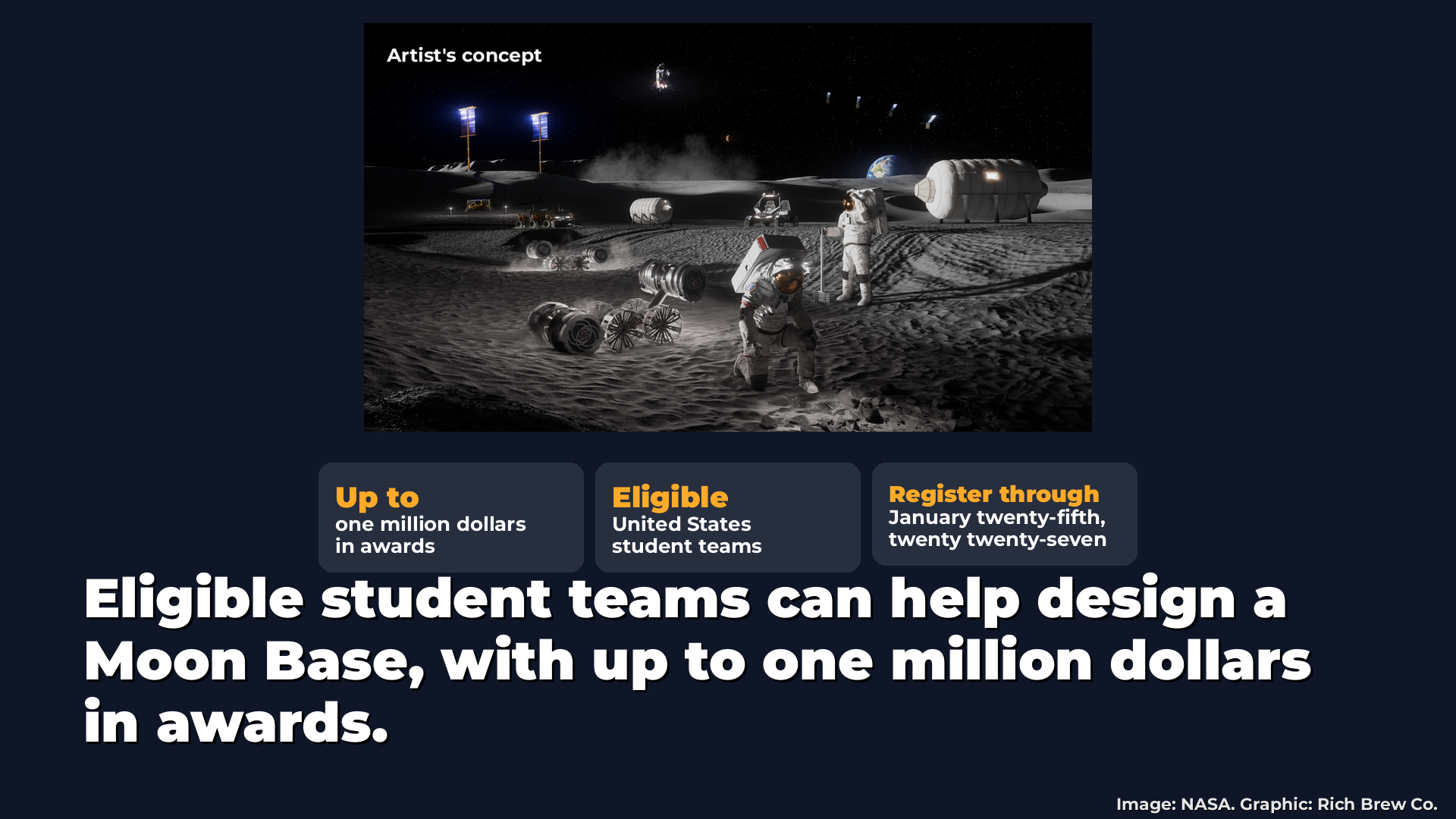
Helping people live on the Moon does not have to begin with an astronaut application. A new student challenge asks teams to tackle the practical systems a lunar home would need, with up to $1 million in monetary awards available.
A day after NASA opened astronaut applications, this is another way in — this time through student design work, not astronaut recruitment.
NASA announced the challenge on November 8. For a student who enjoys fixing things or explaining an idea to classmates, it offers a concrete starting point. Think of planning a small community: people need power, safe shelter, transport and communication, not just a way to arrive.
Who can enter and when
The competition has high school and post-secondary divisions for eligible United States teams. The official rules require two to five students and a designated adult coach.
Teams must be connected to an eligible United States organization. Post-secondary eligibility is narrower than simply attending any college: institutions must qualify under the U.S. Department of Education’s 2026 eligibility matrix. Foreign citizens may participate only as full-time students at an otherwise eligible United States high school or college.
Registration is through NASA’s STEM Gateway, through January 25, 2027. The published pages do not give a closing hour.
Real problems, not a promised Moon ticket
NASA lists six design categories: power generation and storage, construction, life-support systems, surface mobility, communications networks and astronaut safety.
The agency says participants do not need prior specialized engineering or technical experience. Work includes comparing design choices, proposing concepts and explaining them to decision-makers. Teams start with a concept paper; finalists develop a recorded pitch and presentation.
“You do not have to wait until graduation to contribute,” NASA administrator Jared Isaacman said in the release.
The prizes page describes finalist awards, runners-up and grand prizes across categories and divisions, but does not specify individual dollar amounts. Rules make payments subject to funding and NASA approval.
Ink, not pencil: Up to $1 million is available across the challenge, not a promised million-dollar cheque for one team or a guarantee that designs will be built.
Why regular people should care
For students, teachers and families, the immediate value is teamwork and useful career skills. Keeping future astronauts safe needs people who can explain and improve everyday systems, as well as dream big.
What's next
Check the complete eligibility rules before forming a team. The published timeline lists February 22, 2027, for concept papers and May 6, 2027, for award announcements; dates may change.