
By Maya Quill
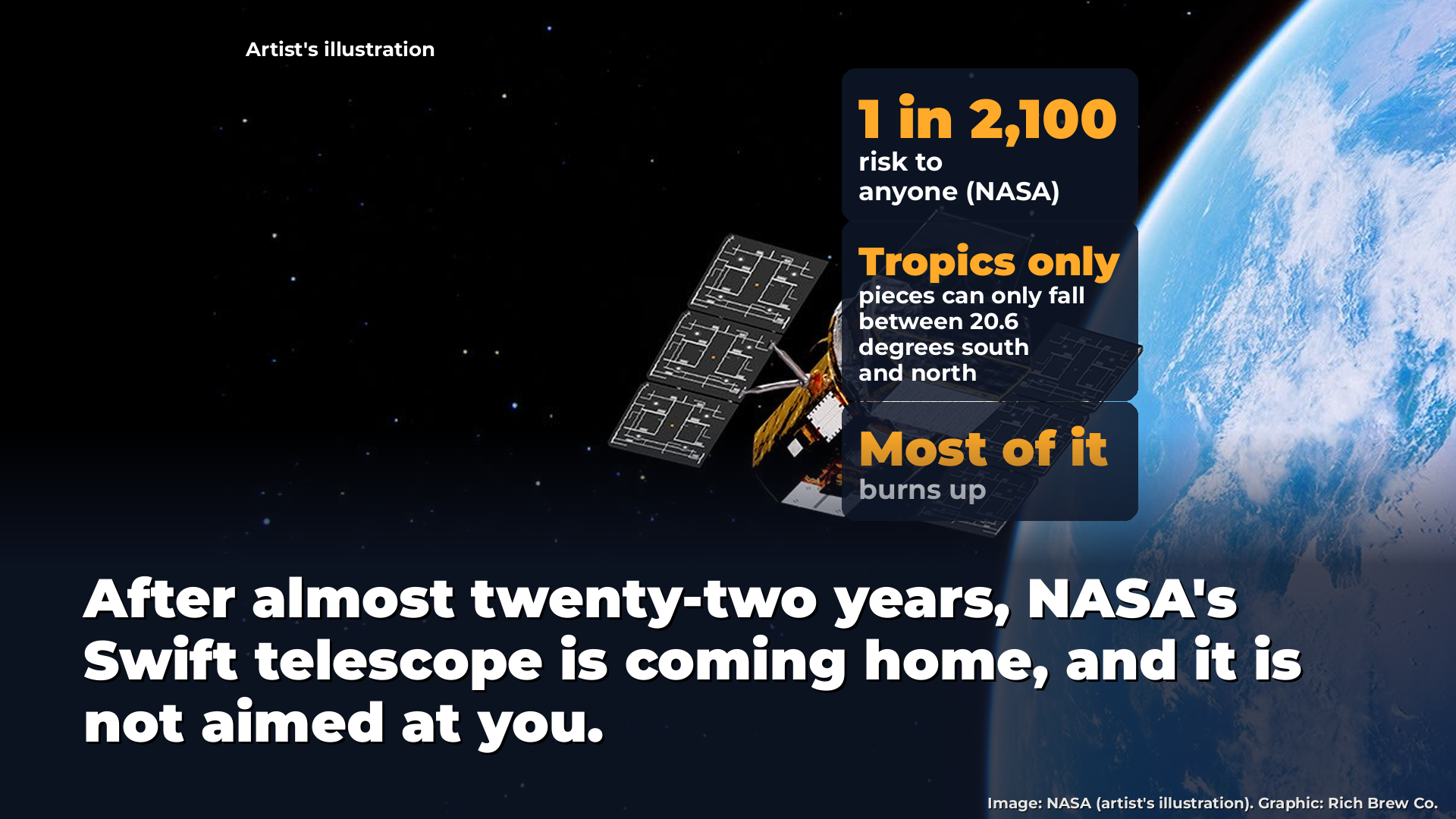
After almost 22 years hunting the biggest explosions in the universe, NASA's Swift telescope has come home. NASA says its Neil Gehrels Swift Observatory re-entered Earth's atmosphere on Wednesday, November 4, over the North Sumatra region of Indonesia. NASA expected most of the 3,200-pound spacecraft to burn up on the way down.
When and where it came down
In an update to its Swift blog on Wednesday, NASA said the U.S. Space Force confirmed re-entry at 7:39 a.m. Eastern time, which is 4:39 a.m. Pacific time (Vancouver). NASA placed it over North Sumatra at about 3.4 degrees north latitude and 98.6 degrees east longitude.
That fits what NASA said beforehand: because of the way Swift circled Earth, any surviving pieces could only fall between 20.6 degrees south and 20.6 degrees north latitude, a band around the tropics that leaves out Canada, Europe and the mainland United States. NASA says "some components may have survived re-entry." It has not said whether any pieces reached the ground, or where.
Before re-entry, NASA had put the chance that anyone at all would be hurt at about 1 in 2,100, which it called "unlikely." The forecasts also moved around: the Space Force's early estimate on November 2 was about 3:30 a.m. Eastern, give or take 11 hours. The confirmed time, 12:39 UTC, fell inside that window.
A long goodbye
Swift launched in 2004 for a two-year mission and kept working for almost 22 years, NASA says. It hunted gamma-ray bursts, which NASA calls "the most powerful explosions in the cosmos," and it could swing quickly toward sudden flashes in the sky and alert other telescopes to look too. For the scientists who kept it going long past its planned life, this is a real farewell.
A plan to save it did not work out. A robotic spacecraft from the company Katalyst Space, called LINK, was meant to push Swift into a higher orbit. In August, NASA and Katalyst said LINK would not capture or boost Swift. On October 23, NASA said Swift had ended its science operations.
Ink, not pencil: NASA says Swift re-entered at 7:39 a.m. Eastern (4:39 a.m. Pacific) on November 4 over North Sumatra, Indonesia, and that most of it was expected to burn up. NASA has not reported any debris found.
Why regular people should care
Old satellites fall back to Earth fairly often, and headlines can make it sound scary. The useful facts are simple: when, where, and how likely. Swift came down over the tropics, as NASA said it would, and it leaves behind more than two decades of science about the universe's biggest blasts.
What's next
Watch NASA's Swift blog for any further word on surviving pieces.