
By Maya Quill
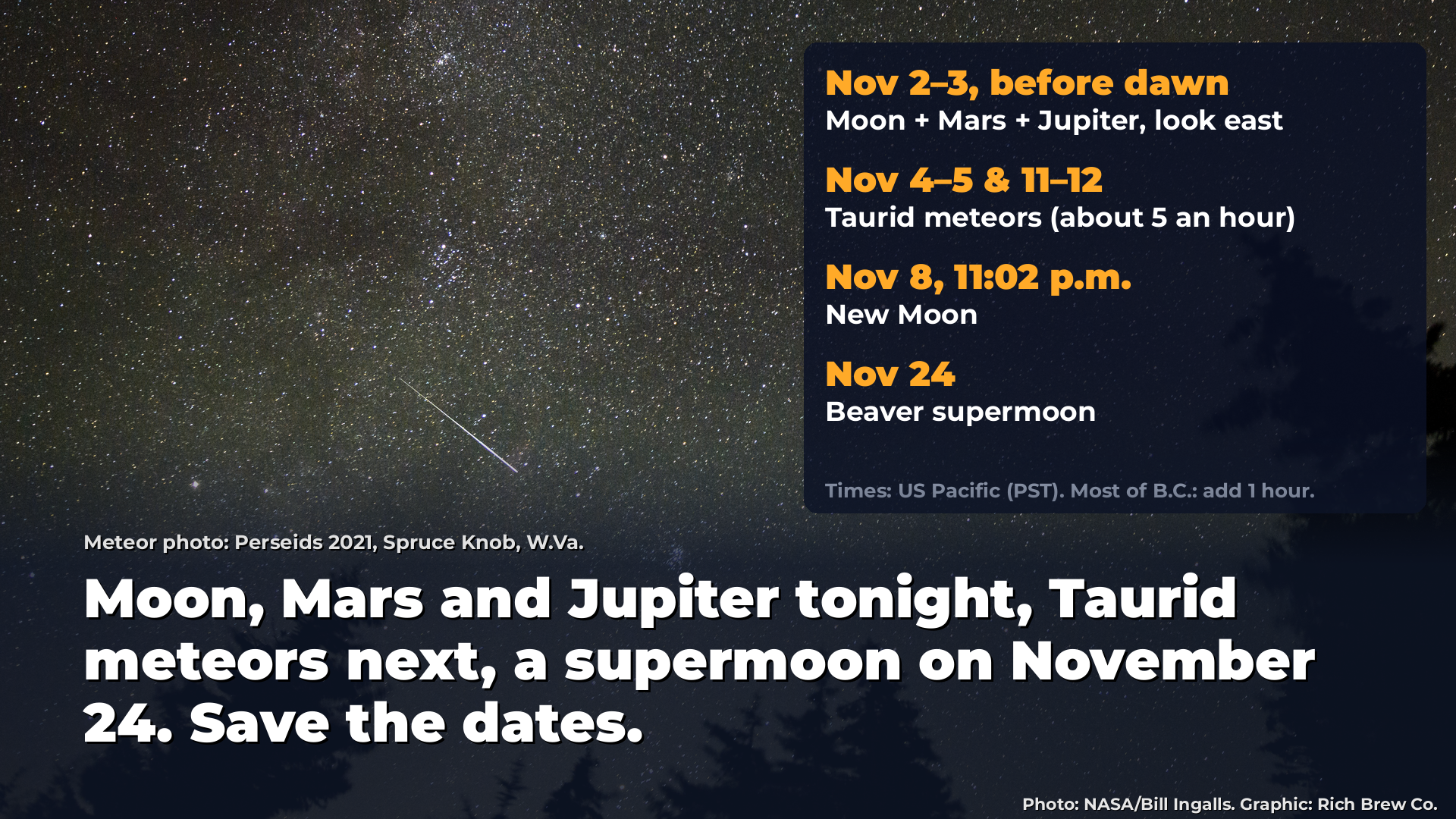
The clocks just fell back across most of the United States and parts of Canada, so the dark now arrives before dinner. That is bad news for evening walks, but good news for anyone who wants to look up. November 2026 has a planet line-up, two gentle meteor showers and a supermoon, and all of it is free. You need no telescope, just a warm coat and a bit of patience.
First, a note on the clock
Daylight saving time ended at 2 a.m. on Sunday, November 1 in most of the US and in the parts of Canada that still change clocks, timeanddate reports. Most of British Columbia did not fall back this year. The province now keeps one time all year, called Pacific Time, seven hours behind UTC, the world's reference clock. So from today, most of B.C. is one hour ahead of Washington state.
Times below are Pacific Standard Time (PST), the clock in California, Oregon and Washington. In most of British Columbia, add one hour. A few parts of northeastern and southeastern B.C. keep their own local time.
Tonight and tomorrow: the Moon, Mars and Jupiter
Late Sunday night into the early hours of Monday, November 2, look east. The waning Moon, reddish Mars and bright Jupiter sit in a line, within roughly six degrees of each other, about one binocular view, National Geographic says. Regulus, the brightest star in Leo, sits just below them. Space.com suggests looking an hour after midnight, when the Moon is less than five degrees from Mars, about the width of three middle fingers held at arm's length.
The group climbs higher until dawn. On Tuesday morning, November 3, the Moon moves close to Regulus, EarthSky says.
The Taurids: few meteors, but sometimes bright ones
The Taurids come in two streams, and both peak this month, according to the American Meteor Society (AMS):
- Southern Taurids: peak overnight November 4 to 5, with the Moon only about 25% lit.
- Northern Taurids: peak overnight November 11 to 12, with the Moon about 4% lit.
EarthSky says each shower gives only about five meteors an hour under dark skies, and they are best around midnight, when the Taurus star group is highest. The peaks are not sharp, so nearby nights work too. Taurids are slow and sometimes very bright, but EarthSky notes that in most years only about 1% of them are fireballs, and the next big fireball swarm is not predicted until 2032.
Ink, not pencil: five meteors an hour means long gaps. Think of it like waiting for shooting stars on a camping trip, not a fireworks show. Give your eyes 20 minutes to adjust, and put the phone away.
Darkest nights and the supermoon
The new Moon arrives at 11:02 p.m. PST on Sunday, November 8, which is 12:02 a.m. on Monday, November 9 in B.C. (7:02 UTC on November 9, per EarthSky). The nights around it are the darkest of the month.
The full Beaver Moon turns full at 6:53 a.m. PST (7:53 a.m. in B.C.) on Tuesday, November 24, per The Old Farmer's Almanac, which suggests watching it rise on the evenings of November 23 and 24. It is the first supermoon since January, National Geographic says, and the first of three in a row. National Geographic says it can look up to 14% larger and 30% brighter than a full moon at its farthest from Earth. In practice, most people will not notice the size change, but a big, orange moon low on the horizon is still a treat.
The human side
National Geographic's night-sky writer, Stephanie Vermillion, suggests using a stargazing app to find your way. It is a small tip that makes a big difference for a child spotting Mars for the first time.
Why regular people should care
This is one of the few shows that costs nothing and works from a backyard, balcony or dark park. The directions here are for the Northern Hemisphere; National Geographic says the Taurids can be seen from both hemispheres, but what you see depends on where you live, how dark your sky is and the weather.
What's next
Mars and Jupiter keep drawing closer, and EarthSky says they pass near each other on the mornings of November 15 to 17. Mark November 4, 11 and 24 on the calendar, and check the forecast for clear skies.