
By Maya Quill
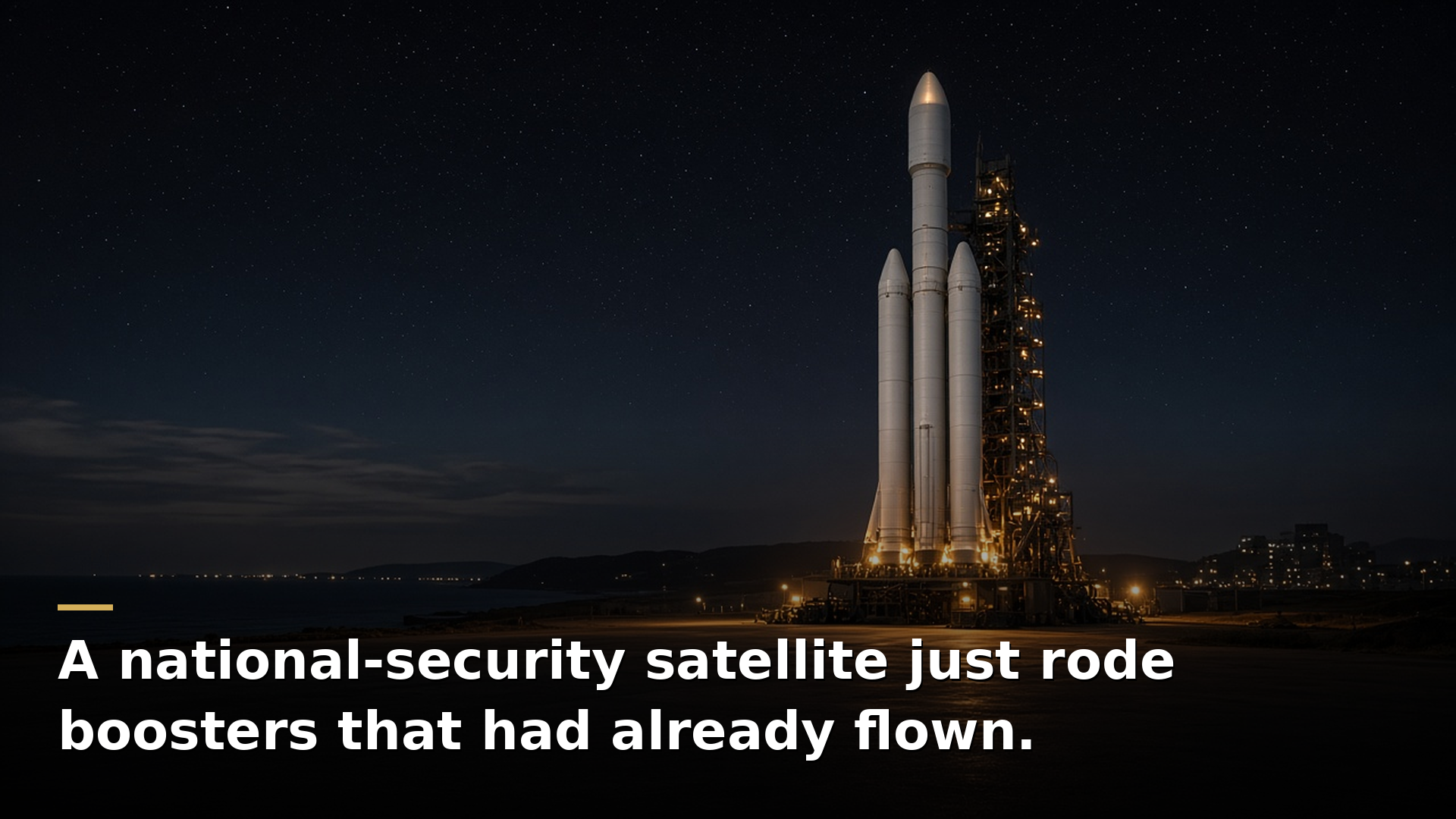
Most of the rocket did not get thrown away. Just before midnight Eastern on Oct. 1, a SpaceX Falcon Heavy lifted a classified national-security satellite from Kennedy Space Center, and the two side boosters flew themselves back to landing pads at Cape Canaveral.
The National Reconnaissance Office, working with the U.S. Space Force's Space Systems Command and SpaceX, launched the mission called NROL-97 at 11:54 p.m. ET (8:54 p.m. PT) from Launch Complex 39A. The NRO says the two side boosters landed at SpaceX's Landing Zones 1 and 2 on Cape Canaveral Space Force Station after they delivered the payload to orbit. What the satellite actually does is classified. What is public is the ride: a heavy rocket whose side boosters had already done this job.
Those side boosters last flew NASA's Nancy Grace Roman Space Telescope on Aug. 30. The payload fairings — the nose cone that shields the satellite on the way up — came from an earlier NRO launch, NROL-95, on July 30. Count the dates the NRO published for the boosters, Aug. 30 to Oct. 1, and you get 32 days. The agency itself said the boosters had supported a NASA mission "only a month earlier," and Col. Ryan Hiserote, who manages the National Security Space Launch program, called that reuse "a 30 percent faster improvement over the previous record."
This was also a first in two senses the NRO was willing to say out loud. Col. Kathryn Cantu, the NRO's director of space launch and the mission director for NROL-97, called it the office's first launch on Falcon Heavy, flown under a contract framework named National Security Space Launch Phase 3 Lane 2. The NRO also says NROL-97 is the first national-security payload launched under that Lane 2 contract, which is built to give extra mission assurance for the most demanding flights. In plain terms: the government office that flies the country's most careful satellites used SpaceX's heavy-lift rocket for the first time, on a new contract written for launches that are not allowed to be casual, and it did it with hardware that had already flown.
Falcon Heavy is three rocket cores strapped together. The two on the sides can come home. Bringing them back is the unglamorous half of abundance in orbit. A heavy launch stops being a one-night firework and starts being a fleet you can turn around — recover, inspect, and fly again — so the next hard satellite does not have to wait on a brand-new booster.
Ink, not pencil: the NRO did not publish a figure labeled "32-day turnaround." That 32 is just the span between the two dates it did publish. The speed claim it actually made is the "30 percent faster" line, measured against a previous record it did not spell out in this release. The payload stays classified, so this story is about the rocket and the contract, not about what the satellite will see.
Monday-morning stake: you will not get a tracking app for NROL-97, and you should not expect one. The part that touches ordinary life is the habit underneath. Maps, weather, timing, and secure links all lean on satellites somebody has to launch, and the expensive slices of the rocket are now landing in Florida instead of the Atlantic. A month-scale turnaround on a heavy booster is how those rides get more routine without getting sloppy.
Why regular people should care
National-security launches sound distant until you remember they share a factory, a pad, and a recovery crew with everything else going to orbit. When a booster can fly a NASA telescope in late August and a classified satellite in early October, the same hardware is doing more work per year. That is how heavy lift gets cheaper and more available — for science, for communications, and for the satellites a country decides it cannot skip. Reuse is not a slogan here. Two boosters left the pad and two boosters came back the same night.
What's next
Watch whether the next NRO heavy mission also shows up on flight-proven Falcon Heavy hardware, and whether later statements put a sharper number on that "30 percent faster" record. Lane 2 is a contract path, not a single launch: the useful question is whether missions after NROL-97 keep the same pace from landing to the next liftoff. The boosters are on the ground at Cape Canaveral. The satellite is on orbit. The public details stop there, on purpose.