
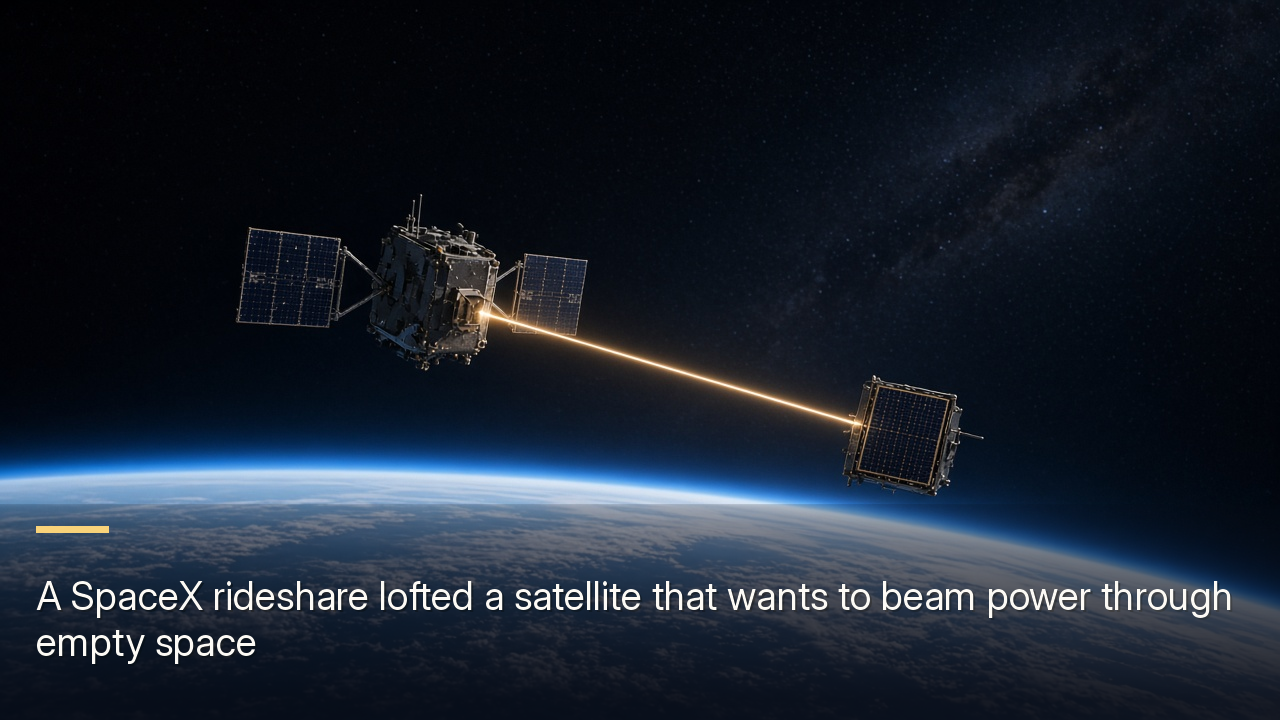
Picture a small satellite that doesn’t just collect sunlight for itself. It finds a neighbor, locks on, and shines usable power across empty space onto that neighbor’s solar panels. That’s the bet Star Catcher Industries is flying with Protostar, its prototype power node.
SpaceX’s Transporter-18 rideshare lifted off from Vandenberg Space Force Base at about 11:32 a.m. PT on Oct. 1, 2026, with roughly 130 payloads aboard. Protostar was among them.
Star Catcher’s pre-launch brief and Via Satellite’s mission roundup put Protostar in the same “firsts” class as other Transporter-18 milestones. After commissioning, the node is meant to deploy and track a CubeSat, then beam measurable optical power onto off-the-shelf solar panels. If it works end-to-end, the company bills it as the world’s first optical power transfer between two free-flying, untethered spacecraft — energy harvesting, acquisition and tracking, and transmission on one orbital stack.
Why chase a power grid in orbit when every satellite already wears panels? Because power is the quiet bottleneck. Earth observation, on-orbit compute, and national-security payloads all want to run hard without redesigning the bus. Star Catcher’s pitch is infrastructure: sell power the way a utility sells kilowatts, so customers keep flying familiar platforms.
The company says it already holds ten major commercial power-purchase agreements (Starcloud, Loft Orbital, Astro Digital, and Aethero among those named), more than 40 letters of intent, an $88 million venture raise, and a $60 million U.S. Space Force STRATFI award. It has also begun work on a follow-on satellite aimed at operational power levels.
Transporter-18 carried other orbital-energy and compute building blocks too — Planet Labs’ Project Suncatcher MVP with Google TPUs, Cowboy Space’s Reason-1 laser-to-ground demo. The rideshare felt themed around getting watts to work in LEO. Protostar’s lane is spacecraft-to-spacecraft beaming, not a rehash of the Suncatcher chip-in-space story. If the beam lands and meters, it’s a step toward treating orbital power as shared infrastructure.
Ink, not pencil: launch and deployment are done; the free-flying optical transfer itself is still ahead. Commissioning has to clear. The CubeSat has to deploy and stay trackable. “Measurable power” on commercial panels has to show up in the telemetry before anyone can stamp “first.” Star Catcher previously set a terrestrial optical-beaming record at NASA Kennedy and flew Sextant Alpha to prove acquisition and tracking software on orbit — useful rehearsal, not the same as two free flyers exchanging watts.
For a busy Monday: if orbital customers can buy power instead of oversizing every satellite’s solar wing, EO constellations, compute nodes, and persistence missions get a new lever — capacity without a full platform redesign. That’s a CapEx story dressed as a physics demo.
Why it matters
Weather maps, disaster-response imagery, and the next wave of space-based computing all hit the same wall: batteries and panels only go so far. A shared power “grid” in orbit sounds sci-fi until you remember that cities already buy electricity instead of each building its own plant. If that model works above the atmosphere, more useful missions can fly without every satellite carrying a denser solar farm — and the people who rely on those services get continuity, not just cooler spacecraft photos.
What’s next
Watch for commissioning updates, CubeSat deploy-and-track confirmation, and whether Star Catcher publishes a measured power figure on the receiving panels. Parallel threads include the company’s follow-on operational node and how PPA customers schedule around early demos. Other Transporter-18 energy and compute tests will move on their own clocks. Protostar’s distinct claim is free-flyer-to-free-flyer optical transfer — prove that, and the infrastructure story gets a real receipt.
Sources: - https://www.prnewswire.com/news-releases/star-catcher-prepares-orbital-power-beaming-demonstration-for-launch-302889921.html - https://www.satellitetoday.com/launch/2026/10/01/the-first-mission-milestones-onboard-spacexs-transporter-18-rideshare-launch/ - https://payloadspace.com/transporter-18-tests-the-building-blocks-of-orbital-data-centers/