
By Maya Quill
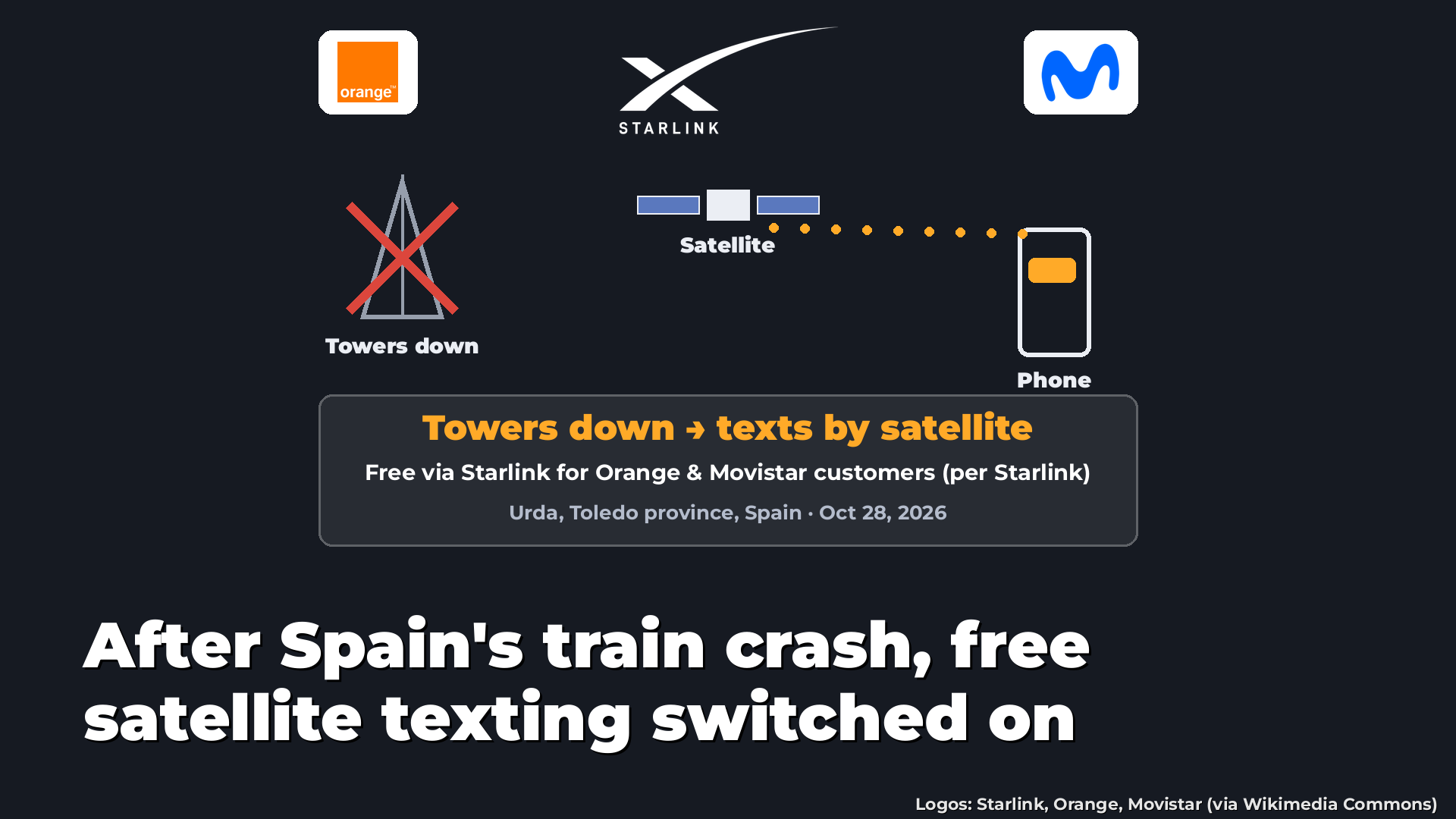
Logos: Starlink, Orange, Movistar (via Wikimedia Commons). Diagram: Rich Brew Co.
When something terrible happens, the first thing most of us do is reach for a phone. Are you safe? Where are you? This week in Spain, when phone towers near a train crash went quiet, ordinary phones could send messages through satellites instead. It is a small piece of help in a very sad story, and a reminder that is useful for all of us.
What happened
On the morning of Wednesday, October 28, two high-speed trains collided on the Madrid–Seville line near Urda, in the province of Toledo. Spain's accident investigation authority says a Renfe AVE train ran into the back of an Iryo train at 8:53 a.m. local time (12:53 a.m. Pacific Time), according to Servimedia.
On Thursday, October 29, the regional government of Castilla-La Mancha put the number of people who died at 69, the news agency EFE reported. Spain's rail accident investigators briefly posted a higher figure that afternoon, then corrected it to 69. The region's emergency service said 42 people were still in hospital as of 2 p.m. local time on Thursday. These numbers may change. The cause is under official investigation, and we will not guess at it here.
When the towers went down
The crash also damaged the phone network around the site. According to the Spanish telecom news site BandaAncha, a letter from Orange said more than 12 cell towers in the area had been destroyed, and up to 18 mobile sites were out of service at first. BandaAncha later reported that 10 of those 18 were working again.
With rescue teams arriving and many people trying to reach each other at once, the area needed extra capacity. Spain's Ministry for Digital Transformation gave emergency permission for satellite coverage, El Español reports.
Orange then switched on Starlink Mobile, a service from SpaceX's Starlink satellite network that can reach ordinary phones directly from space, free of charge for customers in the area. Starlink said Telefónica, which runs the Movistar brand, was taking part too.
What the service does, and doesn't do
On October 28, Starlink wrote on X: "Families, communities, and businesses with compatible LTE phones can stay connected via apps and texts even when cell towers are down."
LTE is the "4G" standard most modern phones use. In plain terms:
- It works on compatible phones, not every phone.
- It is meant for texts and some apps, such as messaging and maps. It is not the same as a full, normal phone signal.
- Orange said customers could use apps and messaging for free "in areas without mobile signal" (our translation).
Elon Musk, whose company SpaceX runs Starlink, replied on X calling the step standard practice, El Español reports. Spanish outlets say this is the second time the service has been switched on in Spain for an emergency, after wildfires in late July.
Ink, not pencil: satellite texting is a back-up, not a replacement for 112, 911 or rescue crews. It can be slower than a normal signal, and it usually works best outdoors with a clear view of the sky.
The human side
Behind each number is a family. EFE reported that by Thursday morning, Spain's Guardia Civil had received 64 reports from people looking for missing relatives. For a parent waiting to hear from a son or daughter on that train, one message getting through can mean everything. Orange's statement ended by sending its support to the people affected and their loved ones.
Why regular people should care
Think of satellite texting like the spare tyre in your car: you hope you never need it, but you want to know it is there and how it works. Storms, fires and accidents can knock out towers anywhere. It is worth asking your own phone company whether your phone and plan can text by satellite, and what it can and can't do.
What's next
Investigators are looking into what caused the crash, and officials may update the number of victims. Orange and Telefónica have not said how long the free satellite service will stay on. We will update this story as official information comes in.