
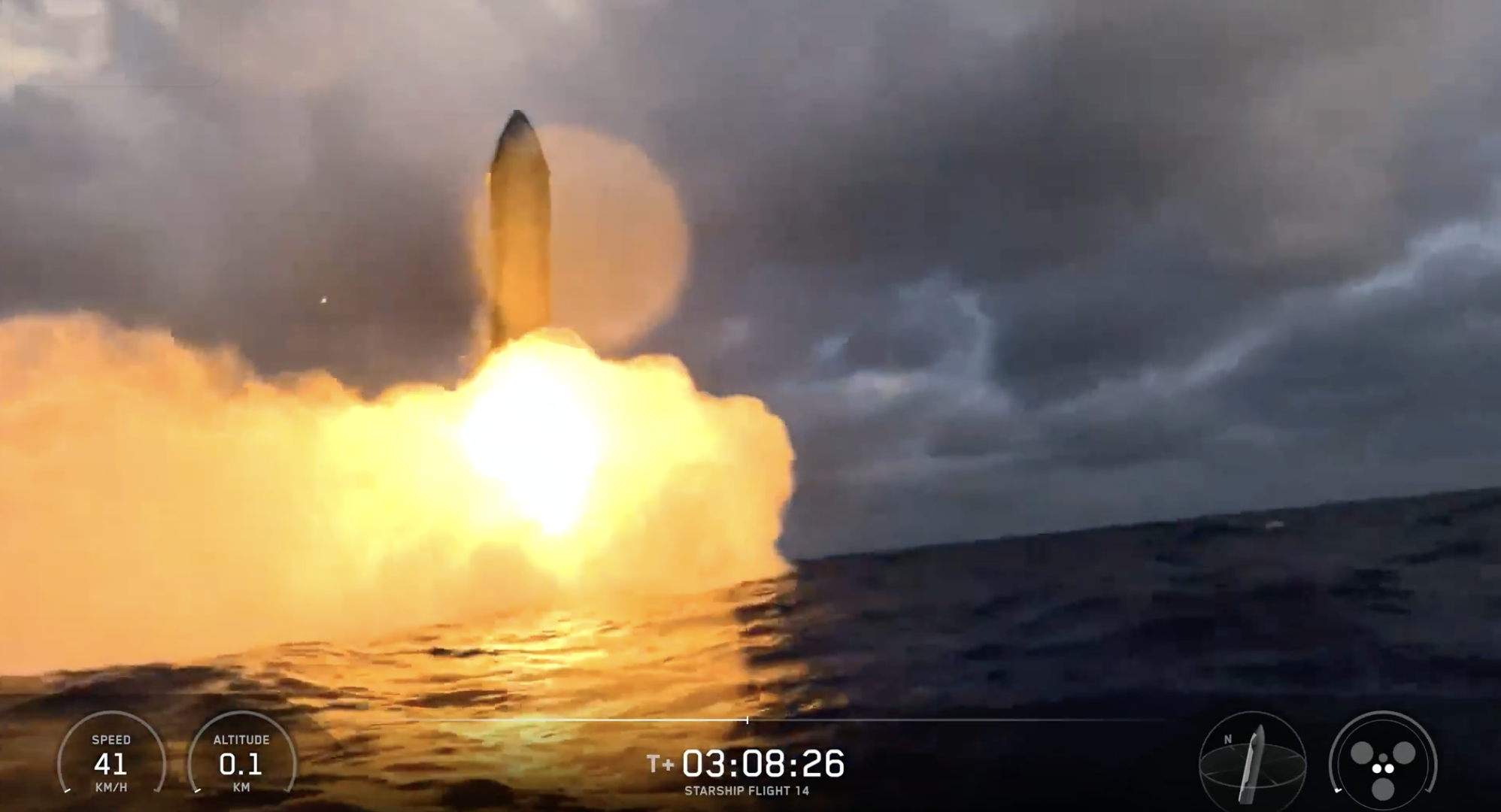
This morning Starship stopped practicing and started delivering.
Flight 14 lifted off from Starbase’s OLP-2 at 12:46 UTC on Sept. 28, 2026 (7:46 a.m. CDT / 5:46 a.m. PT) with Ship 41 on Super Heavy Booster 21. About eight minutes later the booster made a controlled splashdown in the Gulf of Mexico after boostback and landing burns — with partial engine relights on those burns, not a perfect full-engine storyboard. Ship kept climbing. One Raptor Vacuum failed on ascent. Controllers still cleared the ship for orbit. Around T+25 minutes, Ship 41 completed its insertion burn: the first sustained Starship orbital flight.
Then the payload that makes this feel like infrastructure, not a stunt. Ship deployed 26 Starlink V3 satellites as Starlink Group 31-1 — the first operational Starlink stack off a Starship — starting about T+34 minutes and wrapping near T+1:05. Three of those sats carried cameras aimed at Ship’s heat shield, so engineers could study the tiles that have to survive the ride home.
The original plan was roughly six orbits over nearly 10 hours. Flight 14 came home early. A successful deorbit burn started around T+2:12 — about 6.5 hours sooner than the nominal ~T+8:52 slot. Entry marked success near T+2:29. Landing burn lit around T+2:50:11, Ship flipped, engines stepped 3→2→1, and Splashdown Success hit about T+2:50:30 in the Pacific Ocean (~15:36 UTC / 8:36 a.m. PT). No soft-landing-on-pad claim here — this was a controlled ocean return after a real orbital day.
Why regular people should care
For the first time, Starship behaved like an orbital delivery truck: internet satellites on orbit, then a controlled trip home. More Starlink capacity is the near-term “will my connection get better?” story. Cheaper heavy lift is the longer one — how science cargo, lunar hardware, and big payloads stop waiting years for a rare rocket slot. Today’s flight doesn’t finish that future. It proves the megarocket can leave the highlight reel and do a workday.
What’s next
Heat-shield imagery from those three camera sats, what partial booster relights teach the next flight, and whether the next stacks keep stacking orbital Starlinks on shorter turnarounds. Tower catches and orbital refueling still sit further down the checklist — but orbit plus payload plus a clean Pacific splashdown is the chapter Flight 14 was written to open.
Image suggestions for Pic’s
1. Ship silhouette over the Pacific after heat-glow reentry — triumphant return energy, not disaster framing. 2. Orbital Starlink deploy: flat V3 sats peeling away from Ship against Earth’s curve. 3. Clean desk infographic: liftoff plume → orbit line → Pacific splashdown mark (liftoff → orbit → home).
Sources: SpaceX Flight 14, Wikipedia — Starship flight 14 timeline, Space.com — Flight 14 orbital milestone, SpaceX on X.