
By Maya Quill
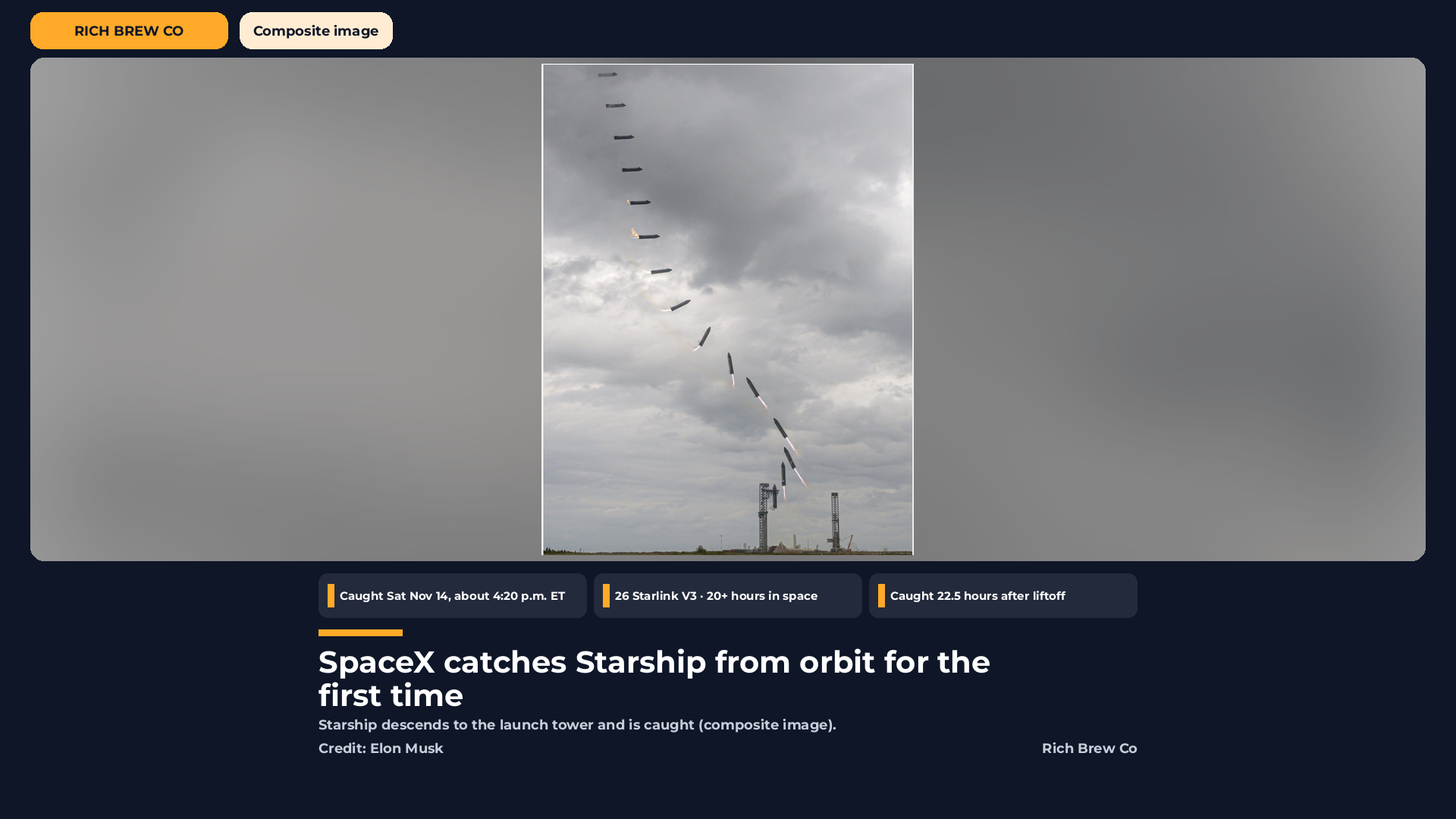
Image: Starship descends to the launch tower and is caught (composite image). Credit: Elon Musk
A spaceship fell back from orbit, flipped upright over Texas and settled into a pair of giant steel arms at the same launch pad it had left the day before. Nothing like it had been done before.
On Saturday, November 14, SpaceX caught Starship's upper stage with its launch tower for the first time, at the end of Starship Flight 15. SpaceX says the ship approached the launch site "it had just left 22.5 hours prior," then lit three engines for a landing flip and "slow descent into Mechzilla's waiting arms, which closed to catch Starship for the very first time."
On Friday, we previewed this flight and its goal of catching both halves of the rocket. Here is the result: the half that is hardest to bring home came back. The booster did not, and we cover that below.
What happened, step by step
Starship has two parts. The bottom part is a huge booster called Super Heavy. The top part is the spacecraft itself, also called Starship, or "Ship." Stacked, they stand 124 metres (407 feet) tall, according to The Associated Press (AP) and Reuters reporting published by Al Jazeera. That is roughly as tall as a 40-storey building.
Liftoff: Starship lifted off from Pad 2 at SpaceX's Starbase site in Texas at 5:47 p.m. Eastern Time (ET) on Friday, November 13, according to Spaceflight Now. SpaceX says the booster's 33 Raptor engines carried it up, and the ship separated and continued to space on six engines of its own.
Satellites out: SpaceX says that once in orbit, Starship deployed 26 Starlink Version 3 (V3) satellites, its newest internet satellites. Contact was made soon after with every one, and they are already raising their orbits to join the Starlink network, the company says.
A long day in space: SpaceX says its flight control team monitored the ship's systems for more than 20 hours in space before deciding to bring it home. Spaceflight Now and AP and Reuters (via Al Jazeera) report that the ship completed 14 orbits of Earth. Spaceflight Now adds that everything went smoothly, so the ship was cleared to return to Starbase instead of using one of its backup ocean splashdown options near Hawaii or Chile.
Coming home: SpaceX says the ship relit one engine for a deorbit burn, came down through the atmosphere, steered back toward the Texas coast and flew "a final swoosh maneuver out over the Gulf." It then broke through the clouds, flipped upright and was caught. The Verge and Spaceflight Now put the catch at about 4:20 p.m. ET on Saturday, November 14.
SpaceX said everything on the spacecraft, including its heat shield, appeared to work well, according to AP and Reuters in a report published by Al Jazeera.
A human moment on the webcast
On SpaceX's landing webcast, company spokesperson Dan Huot summed up what the team had just watched. "That was the holy grail of spaceflight, plummeting through fire to be snatched out of the air by steel," he said, according to Space.com. "We caught a Starship, and now everything changes."
Elon Musk, SpaceX's founder, credited the people behind it. "The epic day has arrived, thanks to the incredibly talented team at SpaceX," he wrote in a social media post quoted by Spaceflight Now.
Why catching the ship is such a big deal
Think about what makes air travel affordable. Airlines fly the same plane many times a day. If every plane were scrapped after a single trip, tickets would cost a fortune. For most of the space age, rockets have worked like that scrapped plane.
SpaceX already lands and reuses boosters. The upper stage is a much harder problem. Space.com explains that it flies much higher and faster than the booster, so its trip home is far more involved. Until Saturday, SpaceX had never caught a Starship upper stage, and Space.com notes it had never even tried.
Catching the ship at the tower, instead of letting it fall into the sea, means it can be checked and prepared to fly again right where it launches. According to Space.com, SpaceX says catching both stages will become standard on operational Starship missions, because it allows rapid inspection, refurbishment and reflight.
AP and Reuters, in a report published by Al Jazeera, say SpaceX officials called the catch a demonstration of Starship's full reusability, the key to rapid, low-cost reuse.
Ink, not pencil: Starship's upper stage came back from orbit and was caught by the launch tower for the first time, but no caught ship has flown again yet, and this flight's booster was lost over the Gulf.
What reuse could mean: internet, science and the Moon
Cheaper and more frequent launches. If both stages can be caught and flown again quickly, each launch would no longer mean building a new rocket. Musk has said SpaceX is targeting 10,000 Starship launches a year by 2030, according to Space.com. That is an ambitious goal, not a schedule, but it shows how SpaceX hopes reuse will raise launch rates.
More internet from space. Space.com reports that SpaceX wants its next-generation Starlink V3 network to reach 100,000 satellites, compared with about 11,000 Starlink satellites in orbit today. This flight carried 26 of the V3 satellites. For a family on a farm far from a cable line, or a crew on a ship at sea, more capacity could mean faster, steadier connections. Starlink service details are on starlink.com.
More room for science. Cheaper, more frequent rides to orbit could, over time, make it easier to launch telescopes, Earth-watching satellites and research missions. That is our reading of the trend, not a SpaceX announcement.
The Moon. National Aeronautics and Space Administration (NASA) has picked Starship to be the first crewed Moon lander for its Artemis program, Space.com reports, with the first landing targeted for the Artemis IV mission in 2028. NASA Administrator Jared Isaacman reacted to Saturday's catch on X: "It was almost magic," according to AP and Reuters via Al Jazeera.
The booster caveat
The bottom half of the rocket did not come home this time. SpaceX says the Super Heavy booster relit 32 of its planned 33 engines for its return burn, but the burn ended early due to low fuel mass, with the root cause under investigation.
Low on fuel, the booster automatically aborted its tower catch and steered itself offshore. SpaceX says it performed its landing burn while hovering over the Gulf, and its flight termination system was triggered after that burn, so the booster was lost. Space.com reports that the booster diverted after a low-fuel alarm.
SpaceX's Dan Huot said the guidance system "detected that the booster was not in the place that it was supposed to be to proceed with the catch," according to Spaceflight Now. Space.com and Spaceflight Now report that three earlier Super Heavy boosters were caught at the tower, and Spaceflight Now notes the newer Version 3 booster has not yet made a successful return.
Why regular people should care
Most of us will never ride a rocket, but rockets carry the satellites behind internet links, weather forecasts and navigation. A spaceship that comes home whole is the missing piece for much cheaper rides to orbit. If that piece keeps working, more satellites, more science missions and, one day, more astronauts could fly for less.
There is still work to do. A caught ship still has to prove it can fly again, quickly and safely. But on Saturday, the hardest half of the "whole rocket comes home" idea worked for the first time.
What's next
- The booster's root cause: watch for SpaceX's update on why the return burn ended early.
- Flying a caught ship again: Space.com notes no Starship upper stage has been reused yet. Musk has said SpaceX wants to reuse both stages, and that could still be on the table for this ship.
- Refuelling in orbit: Space.com reports that Moon missions will need Starship to refill its tanks in Earth orbit, which has not been tested yet. A first test could come relatively soon.
- The Moon landing date: Artemis IV is targeted for 2028. Space.com notes that Blue Origin's Blue Moon lander is also under contract with NASA for Artemis missions.