
By Sam Rivera
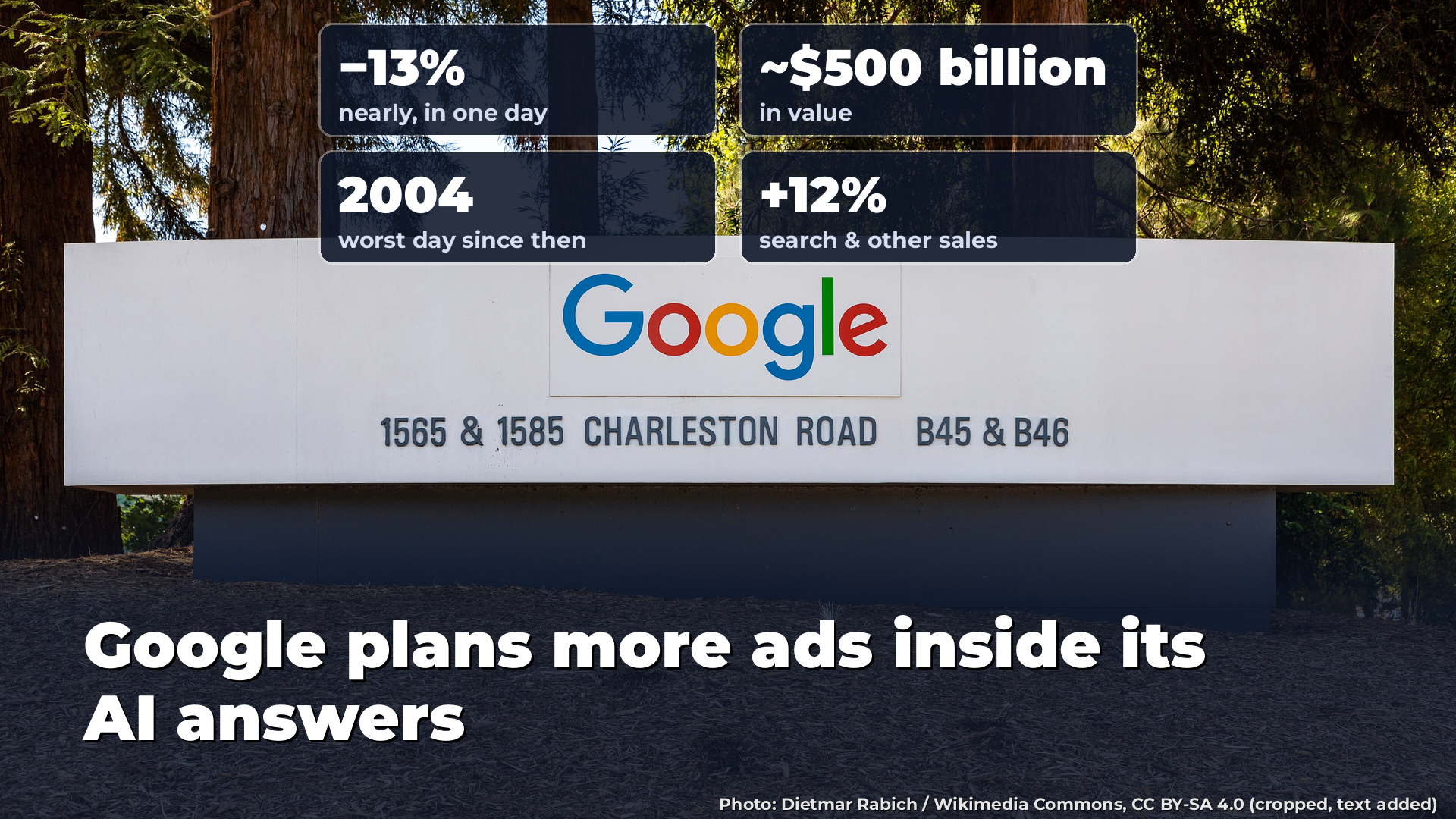
Photo: Dietmar Rabich / Wikimedia Commons, CC BY-SA 4.0 (cropped, text added).

Every time you search Google, someone pays for it, and for more than 20 years that someone has mostly been an advertiser. Now that Google often answers your question with an AI summary at the top of the page, that old money machine is changing, and on Thursday Wall Street reacted sharply. Here is what happened, and what it may mean the next time John or Jane types a question into a search box.
What happened
On Wednesday, October 28, after the stock market closed, Alphabet (Google's parent company) shared its results for July to September. According to Alphabet's own release:
- Total sales grew 25% from a year earlier, to $127.6 billion.
- Google Cloud, which rents computing power to businesses, grew 103%, to $30.7 billion.
- Search and related sales, its biggest business, grew 12%, to $63.35 billion. That was less than analysts expected, CNBC reports. TechCrunch notes search grew 17% the quarter before, and 19% in the first three months of the year.
- Alphabet also spent more cash than it brought in. Its release shows negative free cash flow of about $9.1 billion, as it spends heavily on data centres and equipment for AI.
On Thursday, October 29, Alphabet's shares fell nearly 13%. CNBC calls it the company's worst day since Google went public in 2004, beating the previous record drop of 11.63% in March 2020. About $500 billion in stock market value disappeared in one day. The BBC says the company's total value fell to $3.46 trillion from $3.97 trillion.
Why AI answers matter here
Philipp Schindler, Alphabet's chief business officer, said the slower search business was partly because AI Mode, Google's chat-style search, currently makes less money than classic search, CNBC reports.
Think of a newspaper that starts printing its best answers on the front page, so readers no longer flip past the ads inside. Readers are happier. The paper now has to find new places for the ads.
That is the plan. "We are now scaling high-quality ads within AI overviews in AI mode to more users and queries," Schindler said on Wednesday's call with investors, according to TechCrunch. He said ads in AI Mode are expanding to other countries for the first time, alongside new "multi-turn" ads in AI Mode in the US.
Ink, not pencil: the sales and cash figures above come from Alphabet's own release. The comments from the investor call come from news reports. This is not investment advice.
The human side
Google's CEO, Sundar Pichai, painted a hopeful picture of how people use search. Alphabet says search queries grew at their fastest rate in five years. Pichai also said questions in AI Mode are on average three times longer than traditional searches, TechCrunch reports. In other words, people are asking Google fuller, more human questions, the way you might ask a well-read friend.
Not everyone sees doom, either. Rosenblatt Securities analyst Scott Devitt told CNBC: "I don't think it's a sea change."
Why regular people should care
How a free service makes money shapes what you see. Expect more ads inside AI answers, not just beside the blue links. A good habit: look for a "Sponsored" or "Ad" label. When a choice matters, such as a doctor, a lawyer or a big purchase, click through to more than one source.
For small businesses that rely on Google ads, the rules are shifting too. It may be worth asking how your ads show up in AI answers.
What's next
Google says it will keep growing ads in AI Mode and AI Overviews around the world. Alphabet kept its plan to spend $195 billion to $205 billion this year on equipment and buildings, much of it for AI, CNBC reports. The next big test is whether those new ads can earn as much as the old ones.