
By Sam Rivera
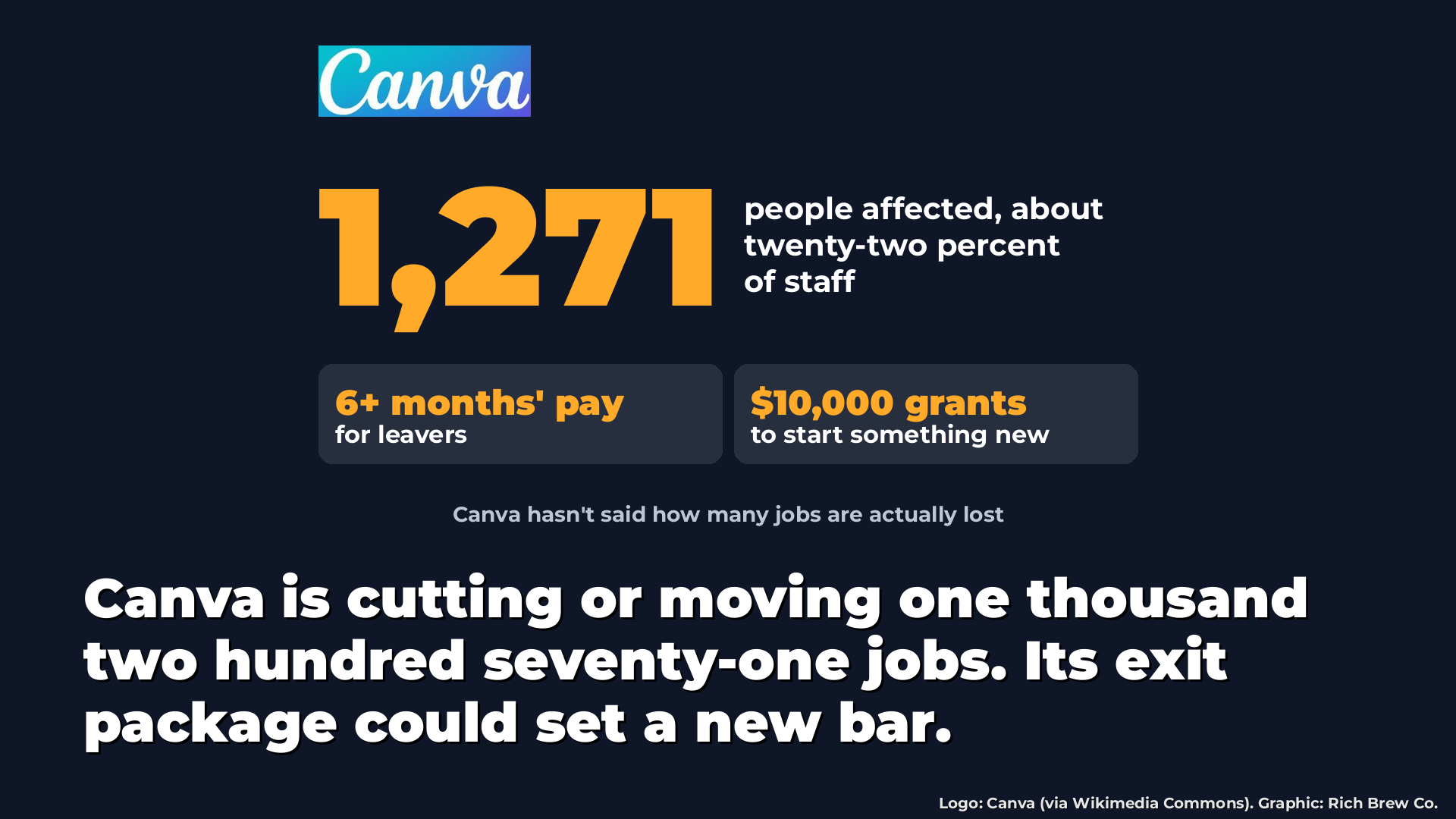
If you have ever opened Canva to make a flyer, a pitch deck or a birthday invitation, you already know the product. Behind it are thousands of people. On Wednesday, co-founder and chief executive Melanie Perkins told staff that 1,271 people, about 22 percent of Canva, will be affected by a major restructure.
What "cuts or moves" actually means
Perkins' staff email, published in full by Times of India Gadgets Now, spells out three kinds of impact. For some people, it means changes to their roles. For others, it means being asked to relocate to central hubs. And for some, it means leaving the company.
Canva has not said how many people fall into each group. The Guardian notes that Perkins "did not specify the exact number of job losses." So "1,271" is the number of people touched by the plan, not a confirmed headcount of firings alone.
Think of a big office reorganisation at a hospital or a school district: some staff keep working but in a different seat, some are asked to move cities, and some leave. The headline number covers all three.
Why Canva says it is doing this
Perkins called the moment "without doubt the hardest moment in our thirteen-year history." She wrote that it had been "our hardest year yet" and that Canva's growth "has slowed for the first time in a decade," the BBC reports. In the email, she said Canva needs clearer ownership, fewer overlapping layers, and more teams working in person. Sydney will become the "primary home" for more product teams, and Canva will bring Product, Growth and Platform into one product organisation. From January, most hybrid staff are expected to spend about two to three days a week in the office.
Ink, not pencil: Canva's own announcement did not blame artificial intelligence (AI). The Guardian notes that unlike some peers, Canva "did not mention AI in its restructure announcement." The BBC reports that Canva's reported value has dropped amid wider concerns about AI's effect on software businesses, and quotes Perkins saying "new technology is transforming what people can create." That is reporters and market context talking. Perkins' email focuses on slowed growth and how the company is organised.
The exit package, in plain numbers
For people who are leaving, Perkins listed support that includes:
- at least six months of salary, inclusive of statutory entitlements, in every location
- 12 more months of healthcare in countries where Canva already provides it, plus 12 months of its employee assistance program for staff and family
- career coaching, interview practice, and one year of LinkedIn Premium
- removal of the one-year share-vesting "cliff" for people who joined in the past year
- the option to keep their Canva MacBook
- access to a new Canva Collective Fund, with US$10,000 grants for departing staff who want to start a business or a community project (register interest by December 14; Canva says it will take no ownership or equity)
Nothing can make a layoff easy. For the people packing up their desks, the useful detail is what help is on offer, and what to ask for.
Why regular people should care
Design tools like Canva sit in millions of everyday workflows. When a well-known company reshapes itself, the human story is the workers whose roles change or end. A clear exit package does not erase that pain, but it sets a bar other employers can be measured against. And it is a reminder not to pin every tech restructure on a single cause.
What's next
Perkins said people directly affected would be offered individual meetings with a senior leader, with timing varying across Canva's 37 countries, and that a company all-hands is planned for November 10. Watch for Canva to say how many of the 1,271 roles are true job losses versus moves or role changes.