
By Sam Rivera
Many people have a computer that sits idle most of the day. So the idea sounds great: let it work for strangers while you sleep, and get paid. One network that does exactly this with Apple Mac computers is now telling its members to expect less money, maybe a lot less. The reason is simple: the work their computers do keeps getting cheaper everywhere else.
What happened
Darkbloom is a project from Eigen Labs, a tech company in Seattle. Its software lets anyone with a powerful enough Mac rent out the computer's graphics chip, or GPU (graphics processing unit), to answer AI requests. The requests come through OpenRouter, a service that sends AI questions to many different providers. About 800 people take part, The Register reported on Friday, October 30.
In a message to members on the company's Slack chat channel, an Eigen Labs researcher who goes by Kydo tried to lower expectations.
"Earnings have been low," Kydo wrote. "For most providers, I don't expect that it is going to recover soon."
The numbers
AI work is measured in tokens, small chunks of text. Prices for tokens have been falling fast.
- Best case: Darkbloom estimates a new Mac mini with an M5 Pro chip and 64 GB of memory could earn up to $192 a month, but only if it runs around the clock on a popular AI model, The Register says.
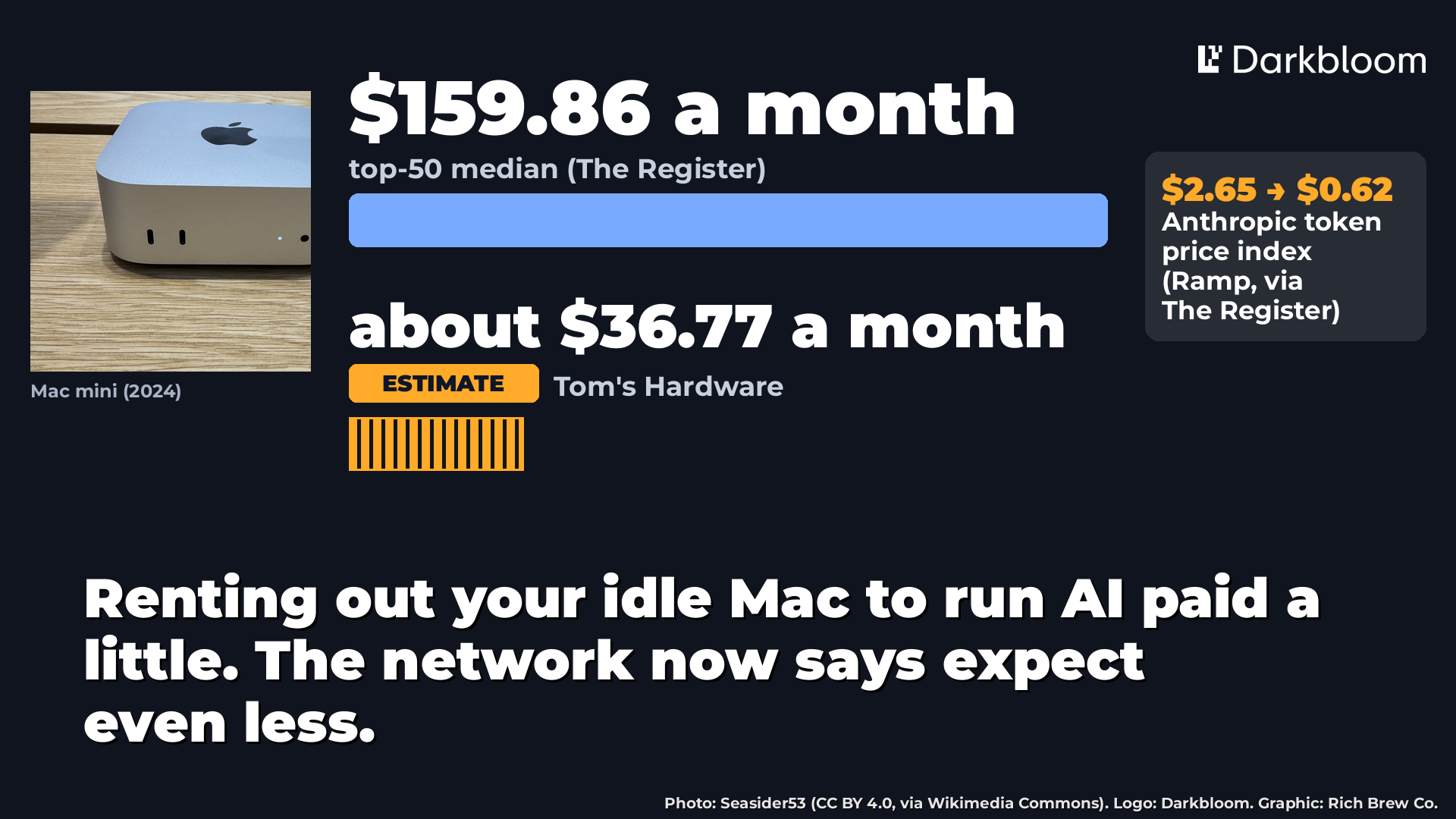
- Real earners: the median of the 50 people on Darkbloom's leaderboard made about $5.26 a day, or $159.86 a month, according to The Register.
- Falling prices: The Register cites Ramp's AI Token Price Index, a market-wide price tracker, not Darkbloom's own prices. It shows the price per million tokens for Anthropic falling from $2.65 on May 1 to $0.62 on October 22, a drop of 77%.
- The estimate: Tom's Hardware did the math: if earnings fall by the same 77%, that $159.86 becomes about $36.77 a month, or about $1.23 a day.
Ink, not pencil: the $36.77 figure is Tom's Hardware's own estimate, not a number Darkbloom reported. It assumes earnings drop exactly as much as that price index. Real payouts could be higher or lower.
Why prices keep falling
Kydo explained it in one line: "Data centers have become cheaper." He said the output of each Nvidia chip cluster is up about 20 times this year, so big computer centres can cut prices sharply and still profit.
"The market caught up to our price," he wrote. "We could go lower, but then most of you would earn even less nothing."
Think of it like renting out your driveway near a stadium. It pays well until a giant new parking garage opens next door and charges half as much. Your driveway did not change; the market around it did.
Kydo also said OpenRouter now cares more about speed than price. For people with older or less powerful Macs, "inference won't be worth running," he said. Inference simply means a computer answering an AI request.
The human side
This story has a reporter inside it. The Register's Thomas Claburn wrote that he had joined the network himself, two days before his story ran. Most members collect "a few cents to a few dollars per day," he reported.
Kydo ended his message with a mix of honesty and hope: "The next stretch will be a fight, and I expect many machines will leave and Slack will get quieter."
Why regular people should care
"Make money while your computer sleeps" offers are everywhere. This is a real-world check. When a product gets cheaper for buyers, the people supplying it often earn less. Before joining any scheme like this, compare the promised payout with what you might pay in electricity and wear on your machine. This is not financial or investment advice.
What's next
Darkbloom plans to steer members toward AI models that are in higher demand, test other kinds of computer jobs, such as running automatic tests on software code, and look for buyers beyond OpenRouter, The Register reports. "We are a driven team and well capitalized. We will not give up," Kydo wrote.