
By Sam Rivera
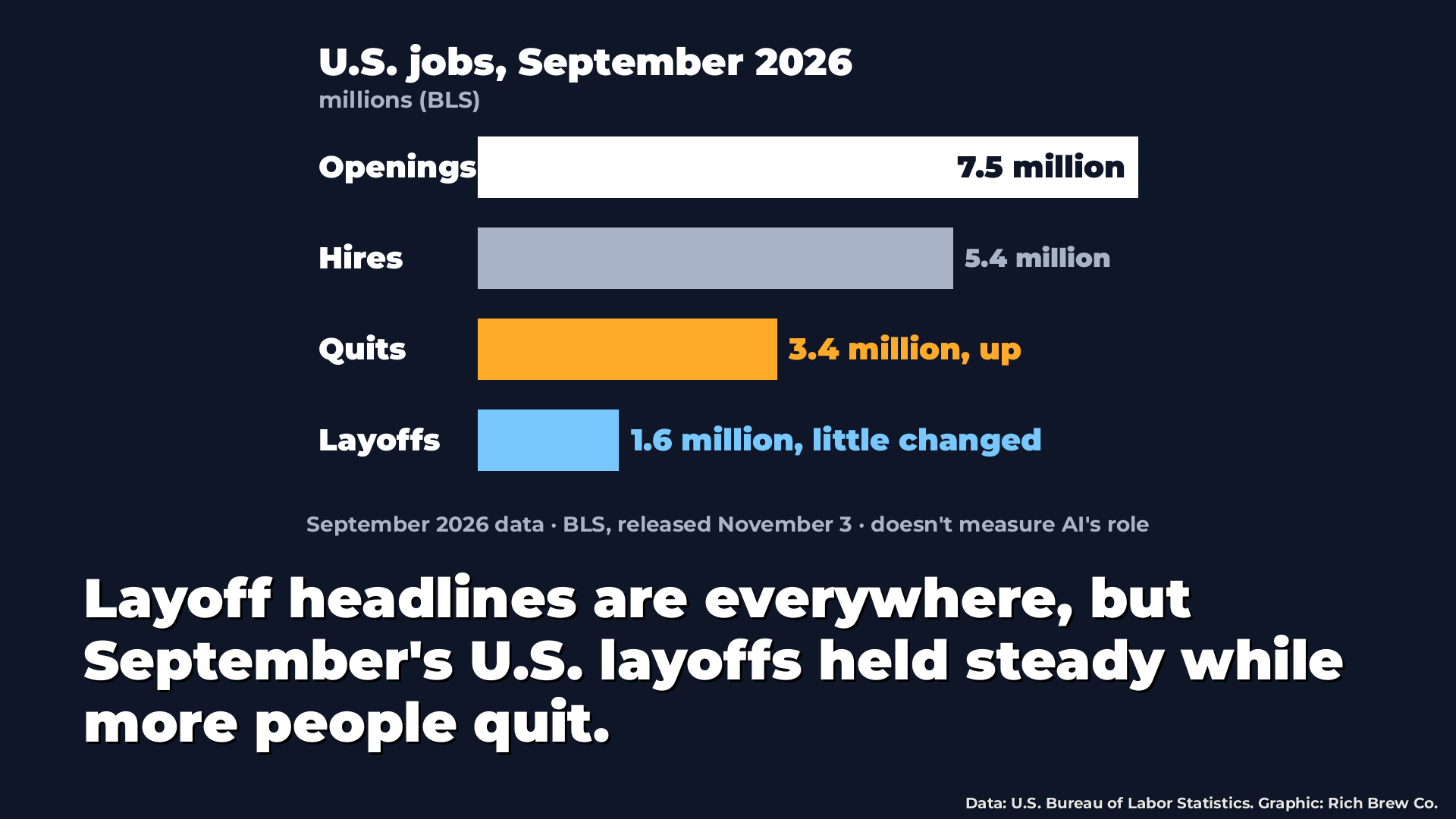
This week brought more headlines about companies cutting jobs and pointing to AI. If you have a job, or are hunting for one, it is easy to feel the ground shifting. New U.S. government data released on Tuesday, November 3, gives a wider view: in September, layoffs were little changed, and more people quit their jobs.
The numbers, straight from the source
The figures come from the Job Openings and Labor Turnover Survey (JOLTS) by the U.S. Bureau of Labor Statistics (BLS), the government's main jobs-data agency. The release came out at 10 a.m. Eastern time (8 a.m. in Vancouver). For September 2026, BLS reports:
- Job openings: 7.5 million, "little changed," at a rate of 4.5 percent
- Hires: 5.4 million, which "changed little"
- Total separations (everyone who left a job, for any reason): 5.3 million
- Quits: 3.4 million, which "increased"
- Layoffs and discharges: 1.6 million, "little changed," at a rate of 1.0 percent
Over the past year, quits rose by 375,000, BLS says.
What quits tell us
BLS explains why quits matter. They are usually people leaving by choice, so the quits rate "can serve as a measure of workers' willingness or ability to leave jobs." In plain words: when more people quit, more people seem to feel they can find something else.
Think of a busy coffee shop. If staff hand in their notice to take jobs down the street, it usually means there are jobs down the street. If the owner is letting people go, that is a different story. In September, quits rose while layoffs held steady.
Where the changes were
BLS points to a few shifts by industry:
- Openings rose in state and local government, excluding education (up 104,000).
- Hires (up 158,000) and quits (up 197,000) rose in accommodation and food services, such as hotels and restaurants.
- Layoffs fell in health care and social assistance (down 70,000).
BLS also revised its August numbers. August openings were revised up to 7.2 million, and August layoffs and discharges up to 1.8 million.
What this does and doesn't say about AI
Ink, not pencil: JOLTS counts openings, hires and departures across the whole U.S. economy. It does not record why a job was cut, so it cannot tell us how many layoffs, if any, were caused by AI.
What it can do is add scale. On Tuesday, we covered two software companies cutting jobs, with AI named as one reason among several. Those cuts are real for the people affected. But across the country, the September layoff rate was 1.0 percent, according to BLS. A few loud company announcements and the wider economy can tell different stories at the same time.
Keep in mind this is a September snapshot, released in November. It does not include anything that happened in October or this week.
The human side
Behind each number are people. Think of a server leaving for a better-paying restaurant, or a coder reading about cuts and wondering if they are next. The data can't tell any one person what will happen to them. It can show that, in September, the overall job market had not turned into a wave of layoffs.
Why regular people should care
If layoff headlines are making you anxious, the official numbers offer calmer context: in September, employers still listed millions of openings, and more workers felt able to move on. That does not mean every industry is fine, or that AI won't change jobs. It means one headline is not the whole job market.
What's next
BLS says the October report comes out on Tuesday, December 1, 2026, at 10 a.m. Eastern time (8 a.m. in Vancouver). Watch whether quits keep rising and whether layoffs stay near 1.6 million.