
By Sam Rivera
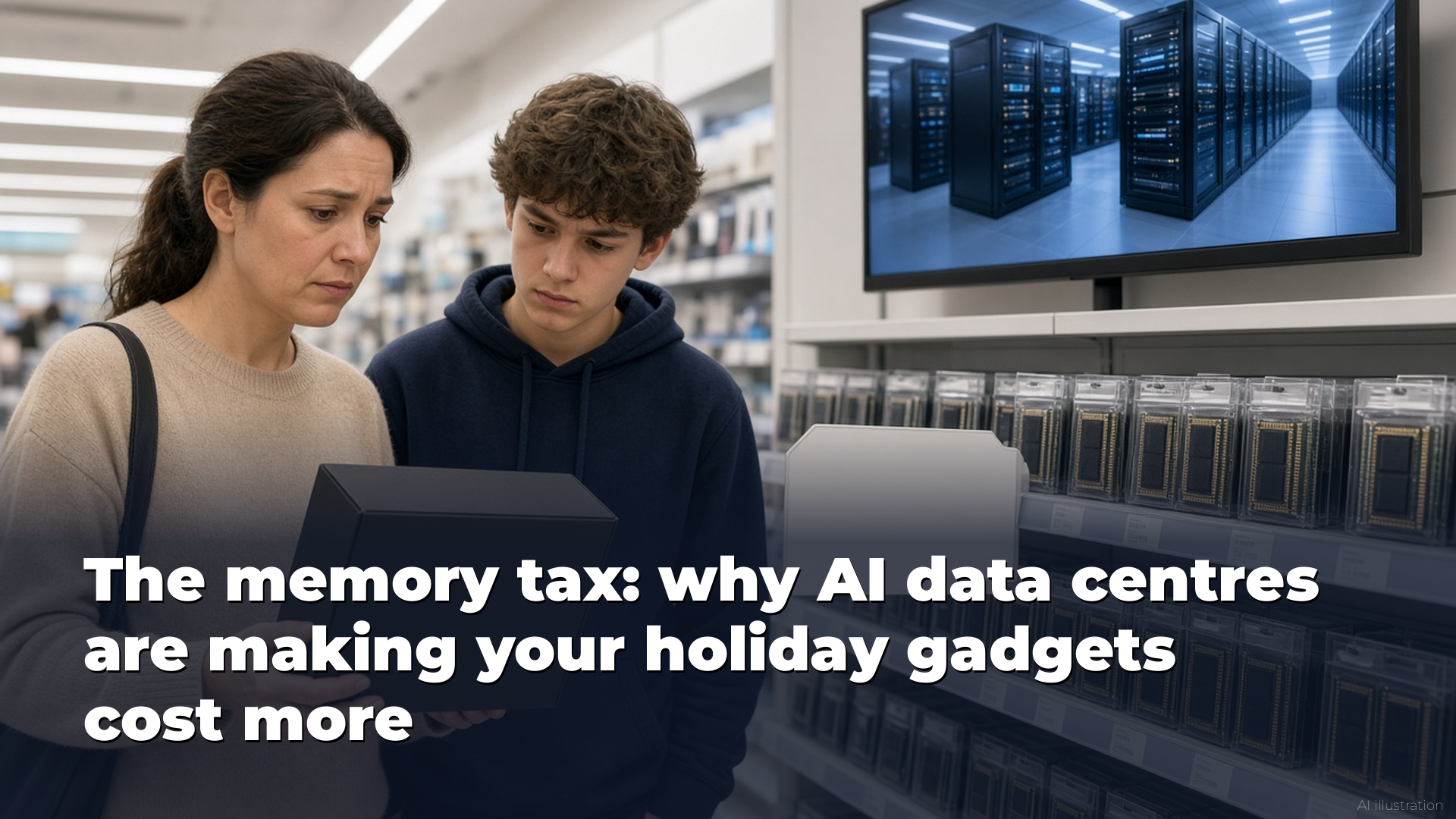
There is a new cost hiding in this year's holiday shopping, and it doesn't appear on any receipt. People have started calling it the "memory tax." It is not a real tax. No government charges it. It is a nickname for something simpler: your next laptop is competing with a data centre for the same chips.
An illustrative example. Imagine Jane and John, a composite couple, not a real family. They want one big gift: a laptop for their teenager, or a new Xbox. The Xbox Series X with 1 terabyte (TB) of storage and a disc drive now lists for $799.99 in the US, according to Microsoft. They aren't buying a fancier machine than last year. They are just paying more for it.
Where the chips are going
Two kinds of memory. Every gadget needs DRAM (dynamic random-access memory), its short-term working memory, and NAND flash, its long-term storage. Data centres need a special stacked kind called HBM (high-bandwidth memory) to sit next to AI chips.
The squeeze. Samsung, SK hynix and Micron make most of the world's memory. Research firm TrendForce says suppliers are focusing their advanced factory lines on server memory and HBM, "squeezing PC and smartphone bit output." Cloud companies pay more, so they get served first.
Think of it like a bakery that gets a huge wedding order. The regular customers still get bread, but there is less of it, and it costs more.
Why AI is hungry. Newer AI tools "think" in long steps and work for minutes or hours on tasks. They must keep all that running context in fast memory. More thinking and more users mean more memory per server.
What the numbers say
Consoles. Microsoft raised Xbox prices from August 1. It said "console storage and memory prices have increased by more than 2.5x and we expect another doubling by the fall of 2027."
US console sales. Circana says Xbox hardware sales in the US fell 33% from January through August, compared with the same months of 2025. Circana says that is the lowest level in its tracking history.
Global PCs. IDC's preliminary count shows worldwide PC shipments fell 20.1% in the third quarter of 2026 from a year earlier. Gartner, which counts differently, puts the worldwide drop at 22.4%. Both tie rising prices to memory and storage costs. IDC adds that some buyers simply bought earlier in the year.
Global phones. Counterpoint Research says worldwide smartphone shipments fell 20% in the third quarter, the lowest third quarter since 2012, based on preliminary data.
Ink, not pencil: "memory tax" is a nickname, not a charge anyone collects. And wholesale chip prices don't pass one-for-one into store prices.
The hopeful view
Not everyone sees doom. Qualcomm Chief Executive Cristiano Amon told the Sources podcast that demand is delayed, not dead, and predicted a phone "supercycle" driven by AI helpers. He also said some leading AI companies are asking for phones that can run very large AI models all the time by 2028. That would need even more memory per phone.
Why regular people should care
You can still shop smart. IDC's Jitesh Ubrani says shops worry about unsold stock, so "promotions are possible," though prices will stay "well above" last year. Microsoft's certified refurbished Xbox consoles sell for up to $100 below list price. Counterpoint says many people are keeping devices longer or buying refurbished. Last year's model, or a smaller storage size plus an external drive, can stretch a budget.
The bigger lesson is a familiar one. When something new and powerful arrives, it quietly changes the price of ordinary things. Knowing why helps you stay calm and choose well.
What's next
Relief takes time. New memory factories are planned, but secondary reports suggest most won't add real supply until 2027 or 2028; we could not confirm every date with the companies. So don't wait for a price crash this year. Watch for holiday deals, compare refurbished options, and buy when the price fits your budget.