
By Jordan Vale
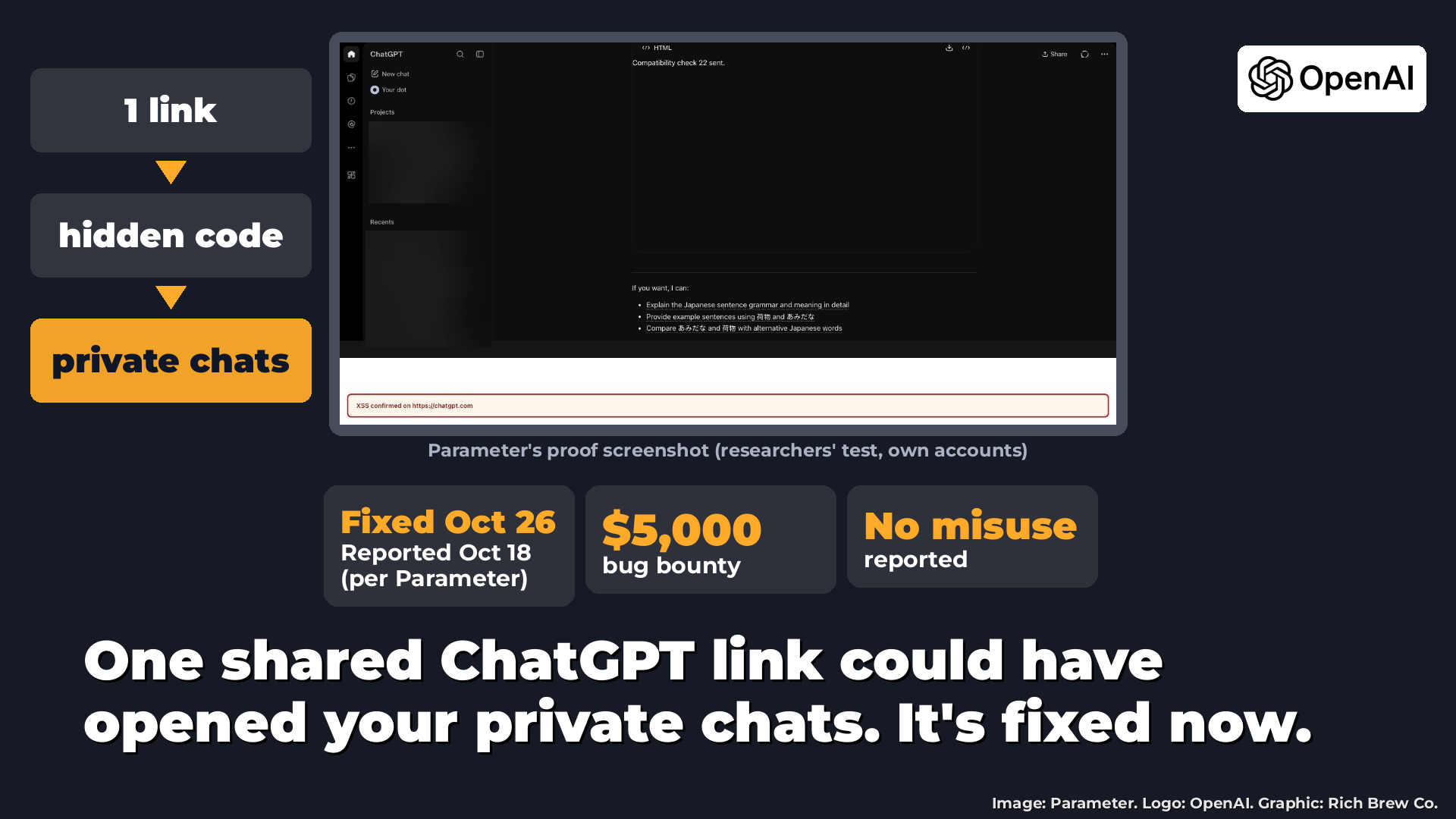
Imagine John gets a message from a friend: "Look at this funny ChatGPT conversation," with a link. He taps it. Nothing strange happens on his screen. But until a fix in late October, a specially built shared link like that could have quietly read John's private chats, according to security researchers. The good news: it was reported, fixed, and there is no sign anyone used it for real.
What happened
Security firm Parameter published a write-up on October 28 by researcher Mukul Goyal. He says the team turned an ordinary public ChatGPT share link into hidden code that ran inside the signed-in account of the person who opened it.
In tests between the team's own separate accounts, Parameter says the code could:
- List the person's recent conversations.
- Pull text from a private chat that had never been shared.
- Send a small piece of it to an outside server the researchers controlled.
"Essentially, we could perform any action on behalf of the victim's ChatGPT account," the researchers wrote. In the most reliable version, the person opened the link and clicked ChatGPT's Preview button once. In a later version, just opening the link was enough.
The Hacker News, a security news site, reported the same findings on October 31, based on Parameter's research.
How it worked, in plain words
ChatGPT can show a small working web page inside a chat, called a Preview. For safety, it keeps that Preview in a locked box, so it cannot touch the main ChatGPT page.
The box held. The way out came from a second, harmless feature in the same chat: an interactive graph. Drawing the graph loaded a maths keyboard tool called MathLive, which listened for messages.
Parameter compares this to a mail slot. The locked Preview could not walk into the main page, but it could drop a note through the slot. That is only safe if the person inside checks who sent the note. This tool did not check, so the note could carry instructions. Two features that were fine alone became a problem together.
The timeline, according to Parameter
OpenAI has not published its own statement that we could find, so these dates come from Parameter's write-up:
- October 18: Parameter reports the flaw through OpenAI's bug bounty program, which pays outside researchers who find security problems.
- October 21: OpenAI reproduces it and raises its severity from P2 to P1, which The Hacker News calls OpenAI's most serious category.
- October 22 to 26: OpenAI rolls out the fix in steps across two versions of the ChatGPT website.
- October 26: OpenAI confirms the fix and pays a $5,000 reward.
- October 28: Parameter publishes its write-up, after the fix.
Ink, not pencil: this was a controlled test. Parameter does not report any real-world use of the flaw, and ran its proof between its own accounts, not against real users. Nobody is known to have been hacked this way.
The human side
Many of us treat a chatbot like a private notebook. People type in health worries, money questions and work drafts. This research is a reminder that a "notebook" on the internet is only as private as every small part around it. It is also a picture of the system working: an outside researcher found the gap, reported it quietly, and the company closed it before the details went public.
It also fits a pattern. Shared AI chat links, which feel as harmless as a photo album link, have raised privacy questions before, as when Meta paused Muse chat sharing in October.
Why regular people should care
You do not need to do anything for this flaw. The Hacker News says the fix is on OpenAI's side, with nothing to install or reset. But the habit is worth keeping: treat a shared AI chat link like any link from a stranger. If it arrives out of the blue, by email, social media or a support message, it is fine to pass. And think twice before typing very private details into any chatbot.
What's next
Parameter says the lesson for builders is that every message between parts of a web page should be checked, and shared pages should be treated as untrusted. For users, there is nothing to update for this one. The lasting habit is simple: take a healthy pause before you tap.