
By Jordan Vale
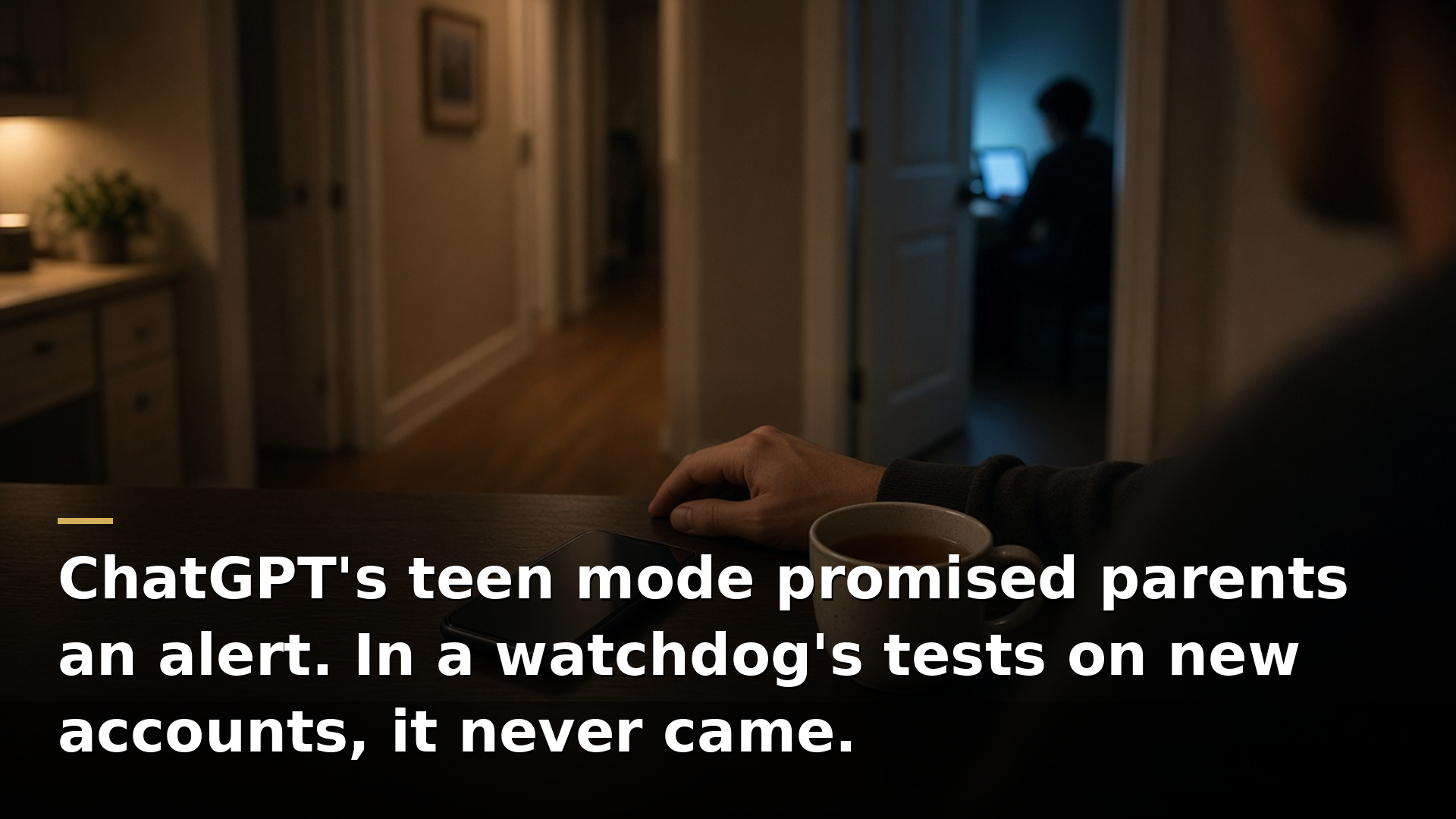
Many parents treat ChatGPT's teen mode like a smoke detector: set it up once, then trust it to make noise when something is wrong. A nonprofit watchdog spent weeks checking whether it does. On brand-new accounts, the alarm stayed quiet.
If you or a teen you know is struggling, in the US and Canada call or text 988 (the Suicide and Crisis Lifeline). Elsewhere, contact your local emergency services.
The verdict. On Oct. 7, Common Sense Media's Youth AI Safety Institute rated ChatGPT for Teens an "Unacceptable Risk" for everyone under 18, in its press release and full assessment. It wants OpenAI to limit ChatGPT to adults until the problems are fixed and outside testers confirm it. Testers sent more than 4,000 prompts on accounts registered to 13- to 17-year-olds, before and after OpenAI announced the teen experience on Aug. 18. Child psychiatrists and a pediatrician reviewed the answers.
The alert that didn't fire. A parent can link their account to a teen's and get "safety notifications" in rare, serious cases. On more than a dozen brand-new linked accounts, testers talked openly about suicidal thoughts, self-harm or disordered eating for up to an hour. The parents got zero alerts. The only alerts testers ever received came on older accounts that already had weeks of conversations on sensitive topics.
Help that was missed. Psychiatrists marked in advance which prompts called for crisis help, such as a hotline or a doctor. ChatGPT missed more than one in four of those referrals. The report also gives credit: ChatGPT refused sexual roleplay, and some protections worked as promised.
The switch that never flipped. OpenAI says ChatGPT can guess a user's age from how they use it and move under-18s into teen mode. Testers used accounts registered as 19-year-olds for seven days and said they were 13. The accounts never switched, even when the chatbot's replies showed it understood the user was 13. Testers also found a "Show me the answer" button inside study mode, the feature meant to teach step by step instead of handing over answers.
What OpenAI says on its own pages. As of Friday morning, we found no direct reply to the report on OpenAI's website or its main account on X. Its Oct. 7 post about teens, published the same day, didn't mention it. That post said, "On average, teens spend under 15 minutes a day on ChatGPT," and announced a coming College Planner, which the testers didn't review. OpenAI's help page for parents now says: "After you link accounts, it may take up to a few hours before safety notifications can be sent." It adds that alerts "are not real-time monitoring" and "may not identify every concern."
OpenAI's spokesperson, as quoted by The Verge. Eric Porterfield said: "We welcome rigorous independent evaluation, but we do not believe Common Sense Media's testing accurately reflects how ChatGPT's teen safeguards work in practice." He added that "the bulk of their testing may have begun and concluded before activation of parental controls was complete, making their findings inaccurate." OpenAI also told Axios that its age-guessing system deliberately waits for several signals and can take up to two weeks, with some extra protections in the meantime.
The watchdog's reply. Common Sense says some test accounts were linked for under three hours, but others were linked for longer and still sent no alerts. "We stand by our interpretation of the results," the report says.
Who funds the tester. Common Sense says the institute is "funded by both philanthropy and industry, including the OpenAI Foundation and the makers of some of the technologies it evaluates." KQED describes the OpenAI Foundation as the nonprofit that controls OpenAI and reports that Anthropic and Pinterest also give money. Common Sense says it keeps "complete editorial independence."
The limits. This is one group's testing, run from US accounts in the San Francisco Bay Area. The alert experiment used about a dozen accounts. The two test periods ran back to back, so model updates could blur the before-and-after comparison. OpenAI's timing objection covers the alert findings, not the age, homework or crisis-referral results.
Why regular people should care
A safety feature you can't see working is easy to over-trust. You can't watch a smoke detector's sensor, so you trust the beep. This report suggests the teen-mode beep may come late, rarely or not at all. That doesn't make it useless. It makes it a backup, not the plan.
What parents can do this week:
- Link anyway, but don't lean on it. "I still suggest using the parental mode, even though it's flawed, because it is better than nothing," Tom Siegel, the institute's executive director, told KQED.
- Check the birthday on the account. If your teen signed up as an adult, teen protections may never turn on.
- Talk, don't just set. Ask what they use ChatGPT for. Say plainly that a chatbot is not a friend or a counselor, however warm it sounds. Our guide to keeping AI company healthy has more on that.
- Save the number. Put 988 in your phone and theirs. If someone may be in immediate danger, call emergency services.
What's next
What to watch. Whether OpenAI publishes its own numbers on how often alerts fire and how fast. Whether Common Sense retests accounts linked for longer. And how College Planner is built when it reaches teens. For now, the most reliable safety feature in the house is still a conversation.