
By Lena Hart
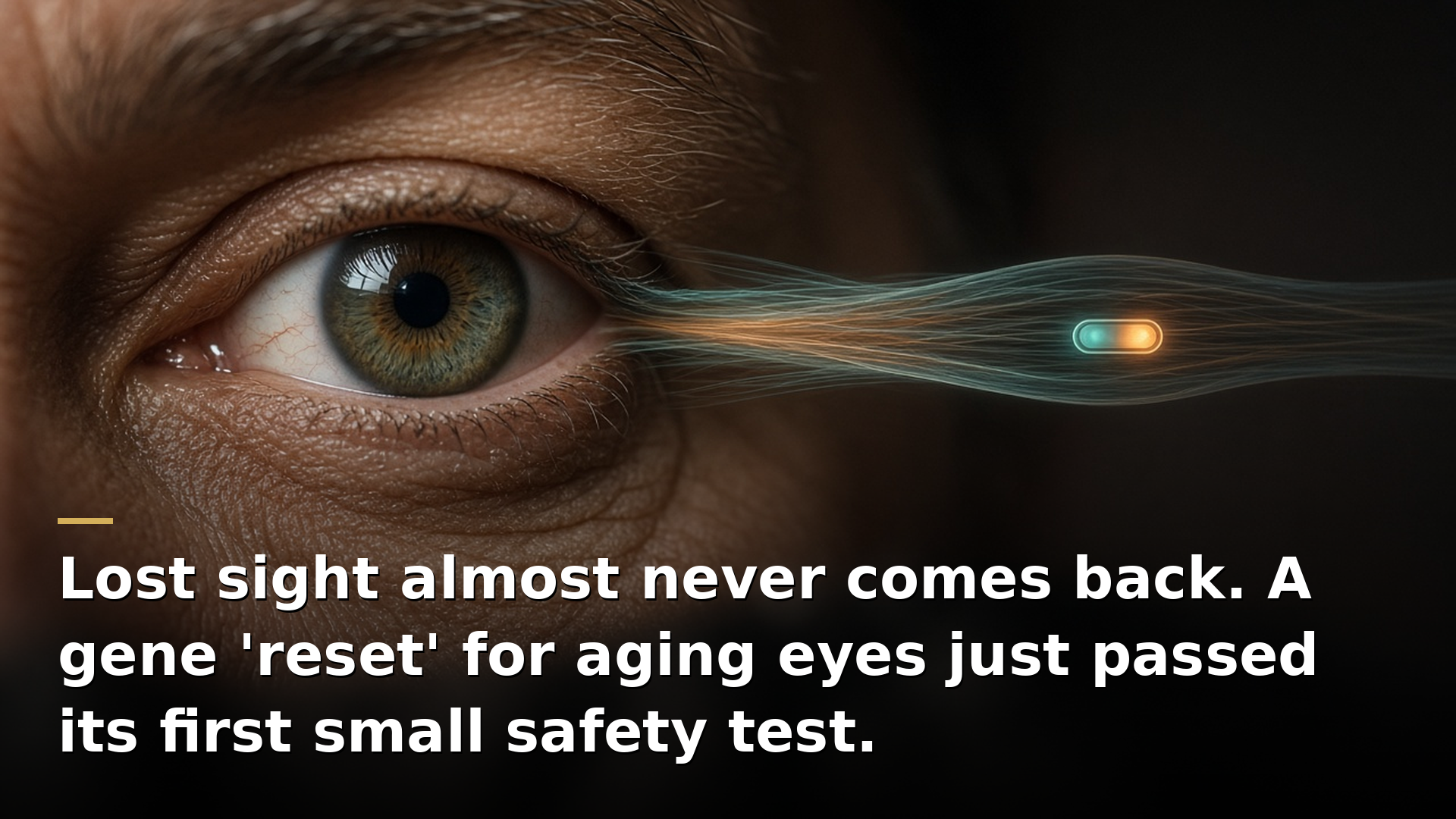
Anyone with glaucoma has heard the rule: treatment can slow the loss, but sight that is gone stays gone. This week, a tiny human study of a gene "reset" hinted that the rule might bend. The hint is real but small, and knowing how small is the useful part.
Glaucoma damages the nerve cells that carry signals from the eye to the brain. Those cells do not grow back, so the loss is permanent, as Life Biosciences, the Boston company behind the study, noted in its October 8 announcement.
What actually happened
Three people with open-angle glaucoma, the most common type, each got one shot into one eye at the lowest planned dose. Then they took a common antibiotic pill, doxycycline, daily for 56 days to switch the treatment on.
The safety news. Through day 56, the company reported no serious side effects. The milder ones, it says, came from the injection, from steroid pills given to calm swelling, or from health problems the patients already had. An independent safety board then cleared a dose three times higher.
The vision news, read slowly. Two of the three did better on a standard eye test. You stare at a center point while faint lights flash around your view, and a machine scores how dim a light you can see, in decibels (dB). In each of those two people, at least 28% of the spots tested improved by more than 4 dB.
That does not mean their vision got 28% better. It means that in over a quarter of the spots checked, they could see a clearly fainter light than before.
The fine print: three people, no comparison group, everyone knew they were treated, eight weeks of follow-up, and company numbers, not a peer-reviewed paper. This eye test also wobbles from one visit to the next. It is a first safety step, not proof the treatment restores sight.
The study is registered as NCT07290244, an early (Phase 1) safety trial in optic neuropathies, diseases of the eye's main nerve. It plans up to 18 adults aged 40 to 85, each followed for up to five years.
How it's made, in plain words
It starts with a famous experiment. In 2006, Japanese scientist Shinya Yamanaka tested 24 candidate genes and narrowed them down to four. Switched on together, those four turned mature mouse cells back into cells that act like they came from an embryo. He shared the 2012 Nobel Prize for it.
Then scientists dropped one gene. A full reset is risky inside a body: a cell that forgets what it is may turn into a tumor. So this therapy leaves out c-Myc, the gene most closely tied to cancer risk. The three that remain, Oct4, Sox2, and Klf4, are called OSK, from their first letters. The goal is a partial reset, like a phone factory reset that clears the glitches but keeps your photos.
Instructions, plus a switch. Scientists write genetic instructions for making the three OSK proteins; the trial record says the treatment does not change a patient's own genes. The instructions stay off until the patient takes doxycycline, like a light you switch on with a pill. Stop the pill, and the light goes off.
A delivery shell. The instructions ride inside an AAV (adeno-associated virus), a tiny virus shell changed so it cannot cause disease. Think of an envelope that carries a letter into a cell.
Grown in big tanks. Gene therapies like this are usually made by growing cells in large tanks called bioreactors, where the cells build the shells and pack the instructions inside. The product is then cleaned and tested. (Life Biosciences has not described its own factory steps.) A doctor then injects it into the clear gel inside the eye.
The rival claim nobody can check
About a week earlier, the KHL Foundation, set up by two longevity campaigners in their 80s, said in its own press release that "a small number of people" had received a different, 11-gene therapy containing OSK, aimed at thinking and memory.
The therapy is unpublished, eight of its genes are not named, and we found no registered trial. The foundation itself says its early observations "do not establish" that the therapy caused any change.
The claim spread partly through Yuri Deigin, who asked on X whether OSK had "already been delivered to the human brain." Deigin is not neutral: he is co-founder and CEO of YouthBio Therapeutics, which is building its own brain version.
Why the experts stay cautious
When the first patient was treated in June, Pete Williams, a neurobiologist at the Centre for Eye Research Australia, told Nature: "It's gotten a lot of hype," adding, "If this goes catastrophically wrong, it might screw us all in the future." Even if it works in the eye, he said, whether the cells are truly "younger" is a bigger question.
Longevity.Technology, an industry news site usually upbeat about this field, said the vision changes "should be read as a signal, not a verdict."
The big risks take time. Tumors, or cells forgetting their job, may not show up in eight weeks. And there is still no FDA (U.S. Food and Drug Administration) approval for treating "aging," as we reported on October 5.
What it means for you
If you have glaucoma today, nothing changes. Keep using the treatments that slow the damage. Next, the trial tries the higher dose, then people with sudden optic-nerve damage from poor blood flow. Watch for longer follow-up, a peer-reviewed paper, and above all a study with a comparison group. That is how real medicine gets built: small, boring, honest steps. Until then, this is a door opening a crack, not a cure.