
By Maya Quill
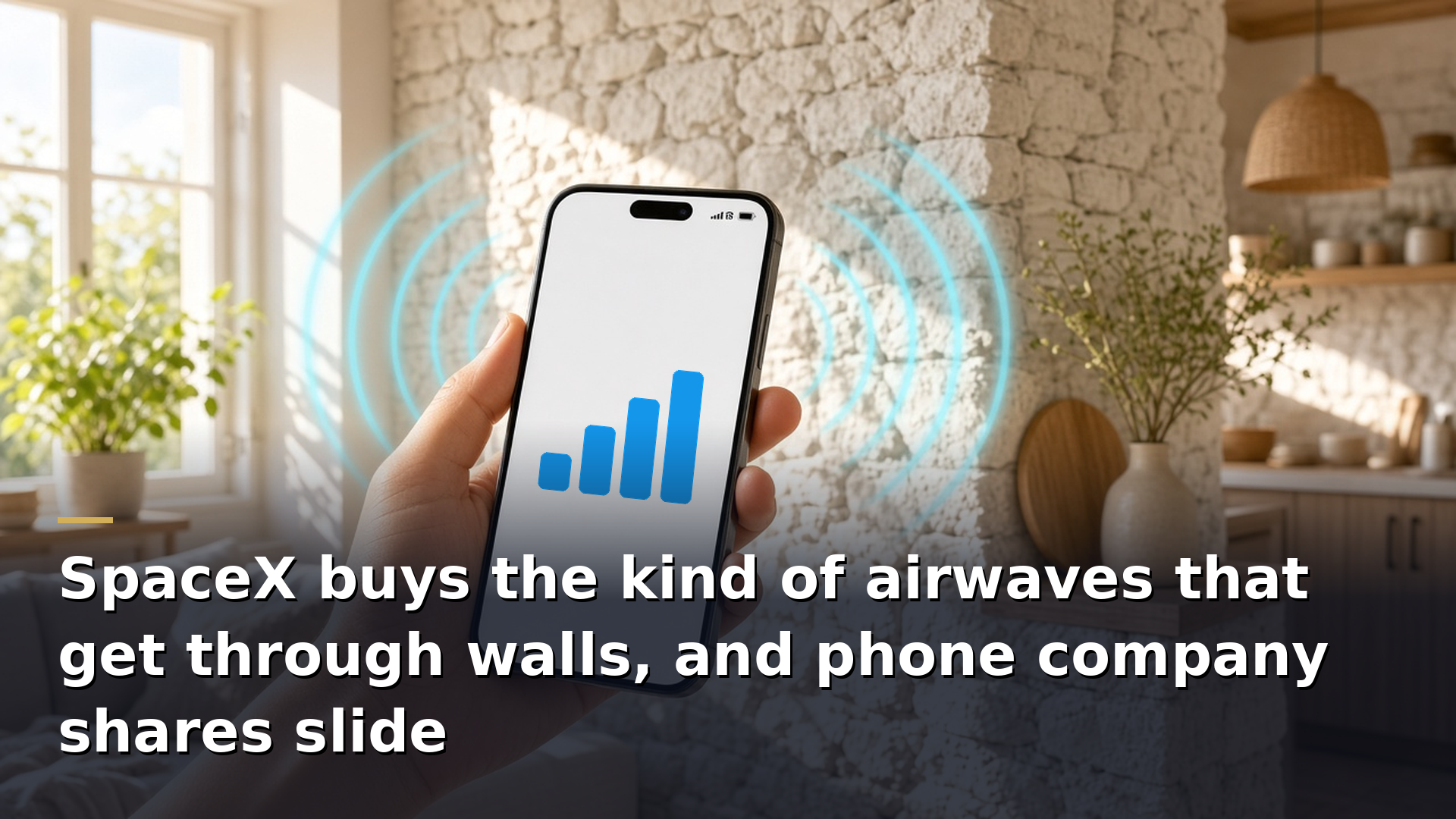
Satellites are great at reaching the middle of nowhere. They are bad at reaching your kitchen.
That is the gap SpaceX is trying to close. On Oct. 8, Grain Management, an investment firm, announced that SpaceX will buy all of its nationwide 800 megahertz (MHz) airwaves. It is the next step after this week's approval for up to 15,000 phone-ready satellites.
What SpaceX is buying. The licenses cover up to 14 MHz of "paired" spectrum, meaning one lane for sending and one for receiving, according to SpaceX's filing with the Federal Communications Commission (FCC). Grain bought these airwaves from T-Mobile in August. MarketWatch reports Grain paid T-Mobile $2.9 billion in cash plus its own 600 MHz licenses. Neither company disclosed what SpaceX is paying. Reuters, citing one person familiar with the talks, put the deal at about $8 billion.
Why "low-band" matters indoors. Your neighbour's party proves the physics. Through the wall, you can't make out the singer, but you feel the bass. Low notes have long, slow waves that lose less energy passing through walls. Radio works in a similar way. Lower frequencies, like 800 MHz, travel farther and get through buildings better than the higher frequencies SpaceX already holds, around 2 gigahertz (GHz). SpaceX's filing describes 800 MHz as offering "long-range coverage, strong performance against terrain and clutter, and superior building penetration."
Towers and satellites together. SpaceX says it would use the airwaves both from space and from ordinary equipment "on towers, rooftops, and other structures." The 2 GHz airwaves would carry the heavy data, while 800 MHz would be the "coverage layer," Telecompetitor reports. SpaceX also says most phones already support the band. "With this new low-band spectrum and our Gen2 constellation, Starlink Mobile can now become the first network operator to deploy both satellite and terrestrial spectrum," the company said, as quoted by MarketWatch.
Wall Street noticed, twice. The news came out after the market closed on Thursday, Oct. 8. In after-hours trading that evening, MarketWatch reported AT&T down 7.9% to $22.90, Verizon down 7.2% and T-Mobile down 7.5%.
Friday's regular session went further. According to Nasdaq's price history, on Oct. 9:
- AT&T closed at $22.18, down from $24.87.
- Verizon closed at $41.65, down from $46.35.
- T-Mobile closed at $148.58, down from $171.31, a fall of about 13.3%.
CNBC put the day's falls at 9.81% for AT&T and 8.75% for Verizon, its worst day since July 2002. Those figures are smaller than the raw price drops, about 10.8% and 10.1%, because both stocks went "ex-dividend" on Friday. That means buyers from that day on don't get the next quarterly payout, so the share price usually falls by about that amount at the open: 27.75 cents for AT&T and 70.75 cents for Verizon. SpaceX's own shares rose about 1%.
Not everyone thinks the giants are in trouble yet. JPMorgan analysts said the deal made Starlink Mobile's long-term chances "more credible," but added that they "continue to see limited near-term risk to U.S. wireless incumbents given the time, infrastructure and capital required to build a competitive terrestrial network," CNBC reports.
What isn't settled. This is an agreement, not a finished deal. It still needs FCC approval and other usual closing conditions, Grain says. Any new towers still have to be built. The licenses come with deadlines: under the default rules, a tower-based network must reach at least 33% of the people or 25% of the area of each license by July 1, 2029, though SpaceX's filing notes it can choose satellite-based targets instead. And speed and coverage claims are SpaceX's goals until real phones test them.
This article is for information only and is not investment advice.
Why regular people should care
Bars where you actually live. Most dropped calls don't happen on mountaintops. They happen in basements, elevators, parking garages and the back bedroom. Low-band airwaves are the tool carriers use for exactly those places. If SpaceX can pair them with satellites that cover the empty map, a fourth national option could appear. A fourth option can mean more choice, and possibly sharper prices. FCC Chair Brendan Carr told CNBC: "It's not for us ultimately to pick winners and losers."
What's next
Watch the regulators, then the rooftops. The FCC has to review the license transfer. SpaceX says that, once approved, it "will deploy rapidly." After that, look for the first towers, the first indoor speed tests and the first Starlink Mobile price plans. Until then, your current carrier's map is still the one that counts.